In 1841, Thomas Cook organised a train trip for around 485 people. That journey, barely twenty kilometres long, marked the beginning of a transformation that would drive the growth of organised travel and lay the foundations for modern travel agencies.
A journey that made history
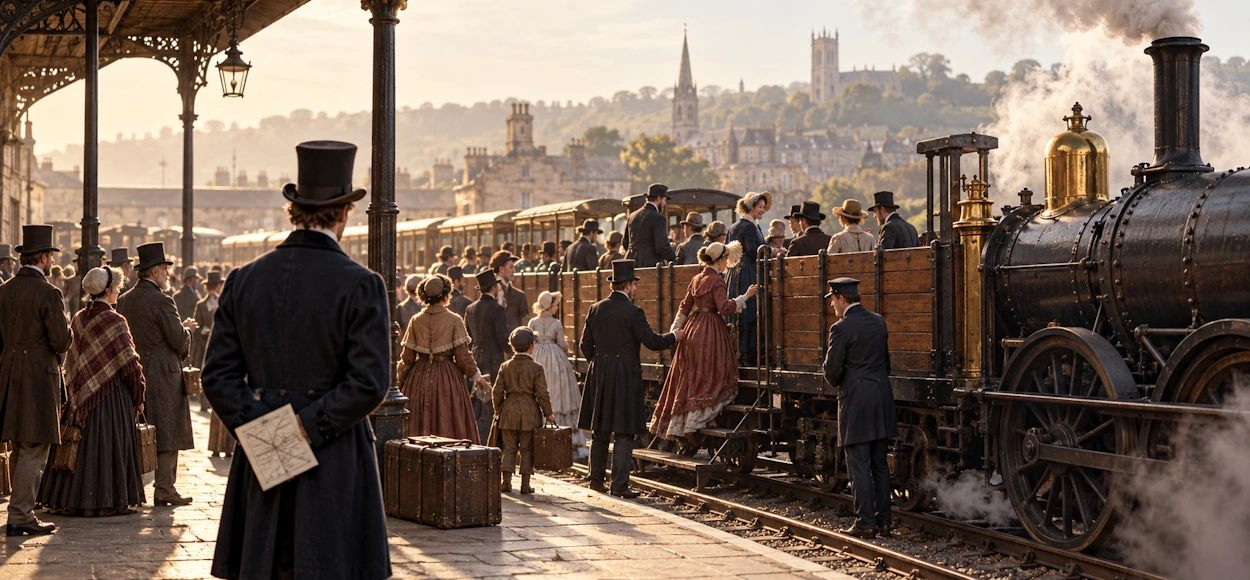
On 5 July 1841, a train set off from Leicester, in England, bound for Loughborough. On board were around 485 people who had paid a shilling to take part in an organised excursion.
The journey was barely twenty kilometres long, but its significance would extend far beyond that single day.
Behind the initiative was Thomas Cook, a 32-year-old cabinetmaker and Baptist preacher who was actively involved in the temperance movement. He had negotiated with a railway company to arrange group transport for those attending a meeting of that movement.
Their proposal comprised three key elements: an itinerary, an agreed price and an organisation that spared travellers the trouble of sorting out the travel arrangements themselves.
It was not the first railway excursion in history, as is often claimed. However, it did set a decisive precedent for the commercial development of organised travel.
The insight that turned an activity into an industry
Until the mid-19th century, travelling for pleasure was a privilege reserved mainly for the wealthy. Travelling was expensive, complicated and, at times, uncomfortable. Each traveller had to sort out their own transport, accommodation and any problems encountered along the way.
The expansion of the railway was beginning to change that situation. Thomas Cook realised that the new infrastructure offered an extraordinary opportunity: by bringing together enough travellers, it would be possible to negotiate better terms and simplify travel.
His most significant contribution was not to have invented the desire to travel. It was to have found a way to turn that desire into a real possibility for many more people.
From day trips to organised holidays
Following that first experience, Cook continued to organise group trips. In 1845, he took a decisive step by organising his first commercial voyage, bound for Liverpool and other destinations in Britain.
To make the experience easier, he drew up a guide containing information about the itinerary and the places the participants would visit. That combination of transport, planning and information foreshadowed the functions that would eventually come to characterise travel agencies.
The business grew rapidly. In 1851, to coincide with the Great Exhibition in London, Cook organised trips for numerous visitors. Four years later, in 1855, he began organising tours of continental Europe, with itineraries covering Belgium, Germany and France.
The world began to feel closer
Thomas Cook’s business ambition was not confined to organising travel within Great Britain. Over time, his programmes came to include European destinations and, later, itineraries through the Middle East and Egypt.
In 1869, he promoted trips to Egypt and the Holy Land, opening up new possibilities for international tourism. In 1872, he embarked on a round-the-world voyage which cemented his reputation as a pioneer of long-distance travel.
The development of these programmes was closely linked to the expansion of the railway and maritime routes. His son, John Mason Cook, was also involved and would go on to play a key role in the international expansion of the family business.
Much more than just selling tickets
Thomas Cook’s true legacy was his realisation that travellers needed more than just transport: they needed information, safety, organisation and trust.
Their work helped to popularise a business model that integrated various services into a pre-planned experience. This led to the development of principles that remain fundamental to travel agencies:
- Negotiating with suppliers.
- Planning itineraries.
- Co-ordinating transport and accommodation.
- Information and advice for travellers.
- Professional guidance and trust in the person organising the trip.
Technology, destinations and consumer preferences have changed radically since then. But the need for someone to facilitate and organise the trip remains as relevant as ever.
The end of a company, but not of its legacy
Thomas Cook died in 1892, having witnessed his venture grow into a business with an international reach. The company that bore his name continued to grow over the generations and became one of the best-known brands in the tourism industry.
In September 2019, the long-established Thomas Cook group went into liquidation and ceased trading, bringing an end to a period spanning almost 180 years. The trade name survived and was subsequently used again in the sector, under a different corporate structure.
An idea that continues to spread
When Thomas Cook organised that tour in 1841, he could hardly have imagined just how much the way people travelled would change. His story shows that major transformations in an industry do not always begin with revolutionary technology.
Sometimes they stem from a seemingly simple idea: understanding what people need and finding a way to make it happen.
Almost two centuries on, tourism continues to evolve, driven by new digital tools and increasingly discerning travellers. But one principle remains: The value of a travel agency lies not merely in selling a trip, but in enabling an experience that the traveller can enjoy with confidence.
That is probably Thomas Cook’s most enduring legacy.
This report forms part of Tourism has a history, the section of Sinergia Skål dedicated to those who have transformed the tourism industry.
Historical sources
- The National Archives (United Kingdom).
- The Story of Leicester.
- European Route of Industrial Heritage.
Featured image: AI-generated historical reconstruction; this is not a documentary photograph.