

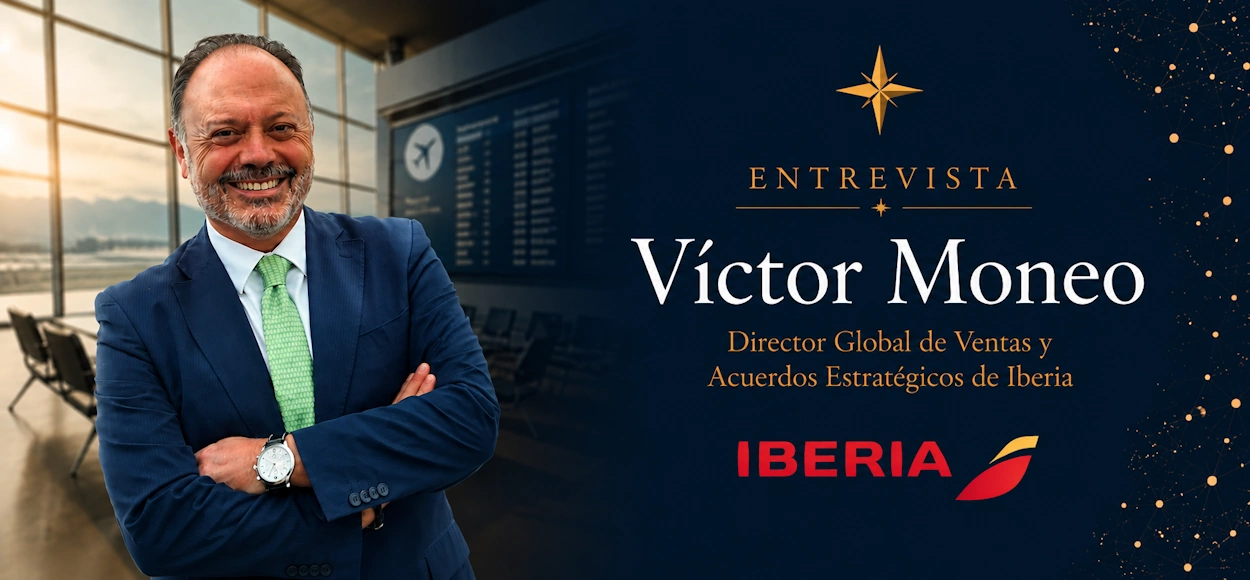
Few people can speak about the transformation of aviation from such a long-term perspective as Víctor Moneo. His professional career has spanned more than three decades in air transport, from his years at Aviaco to the various roles he has held at [company name missing]. Iberia, including agencies and tour operators, airports, sales management in Spain and Latin America and, currently, the Global Sales and Strategic Agreements Management.
In his current role, he oversees Iberia's global sales, as well as the company's strategic agreements. This position marks the culmination of a professional journey that has allowed him to experience aviation from diverse and complementary perspectives.
He has experienced from within some of the biggest changes experienced by aviation and tourism itself: the transformation of distribution, digitalization, the emergence of new company models, the evolution of the traveler and an increasingly connected world.
At Sinergia Skål, we wanted to leverage that experience to look ahead. We spoke with Víctor Moneo about the future of aviation, technology, sustainability, connectivity, and tourism competitiveness, but also about everything that has changed since he began his career and what, after so many years, continues to inspire him.
Víctor Moneo: air connectivity and the future of tourism
More than 120 years have passed since the Wright brothers' first flight. What does aviation represent today beyond simply being a means of transportation?
Aviation has become a great engine that drives everything and without whose existence the evolution and advances of humanity would not have been possible, at least at the frenetic pace of this last century.
Airplanes are not just a means of transport that allows us to travel from one place to another in less time than by road, rail, or sea. They are much more than that. Aviation is progress; it is the tool that allows us to connect people, learn about other cultures, enjoy vacations in places we wouldn't have been able to reach by other means, and start enjoying them in record time.
But it's also a wealth generator. Today, we can't imagine doing business without taking a plane, because it provides us with agility, immediacy, and flexibility.
Aviation and tourism seem to have always evolved hand in hand. To what extent does a destination's competitiveness depend on its air connectivity today?
Wherever a new route opens, the accessibility of a destination increases, economic exchanges multiply, and new opportunities are created for hotels, restaurants, commerce, culture, and services.
In an increasingly interconnected world, air transport is not just a way to get around: it is a strategic infrastructure for the competitiveness of territories.
However, the future of aviation will not simply be about transporting more passengers. It will be about doing it better: with greater efficiency, a simpler experience, a more customer-friendly network, and a progressively more sustainable model.
And the passenger is changing too. What is this new traveler like, the one the sector will have to cater to?
It's more digital, better informed, and more demanding. It compares alternatives, seeks simplicity throughout the travel process, and expects an increasingly personalized experience.
At the same time, the boundaries between tourism and business travel are becoming more fluid: many trips combine work, leisure, gastronomy, culture, or local experiences. This compels airlines, airports, and destinations to understand travel as an integrated experience, not as a collection of separate services.
Artificial intelligence, biometrics, automation… to what extent will technology change our travel experience?
Technology will be crucial in this transformation. Artificial intelligence, biometrics, automation, and the intelligent use of data will allow us to anticipate needs, reduce friction, improve incident management, and offer more relevant options for each traveler.
The airport of the future will be increasingly fluid, and the relationship between customer and company will be more continuous before, during, and after the flight.
Alongside technology comes one of the sector's biggest challenges: sustainability. How can aviation continue to grow while simultaneously reducing its environmental impact?
Aviation faces the challenge of continuing to connect people and economies while progressively reducing its environmental impact.
Fleet renewal, operational efficiency, more effective airspace management and, especially, the development of sustainable aviation fuels will be key elements.
In Europe, the ReFuelEU Aviation regulation establishes a minimum incorporation of sustainable aviation fuel (SAF) of 2 % from 2025, a percentage that will gradually increase to reach 70 % in 2050.
The transformation will be complex and will require investment, innovation, fuel availability at scale, and collaboration between airlines, manufacturers, energy providers, airports, and government agencies.
Are we running the risk of equating sustainability solely with emissions reduction?
Sustainability must also be understood in a broader sense. Sustainable tourism is not only about reducing emissions. It is also about generating economic and social value in the destination, promoting year-round tourism, better distributing visitor flows, and contributing to the development of the region.
And at this point, air connectivity can become a powerful tourism planning tool.
Let's talk about the Costa del Sol. What does it mean for a tourist destination to have the kind of connectivity that Málaga currently offers?
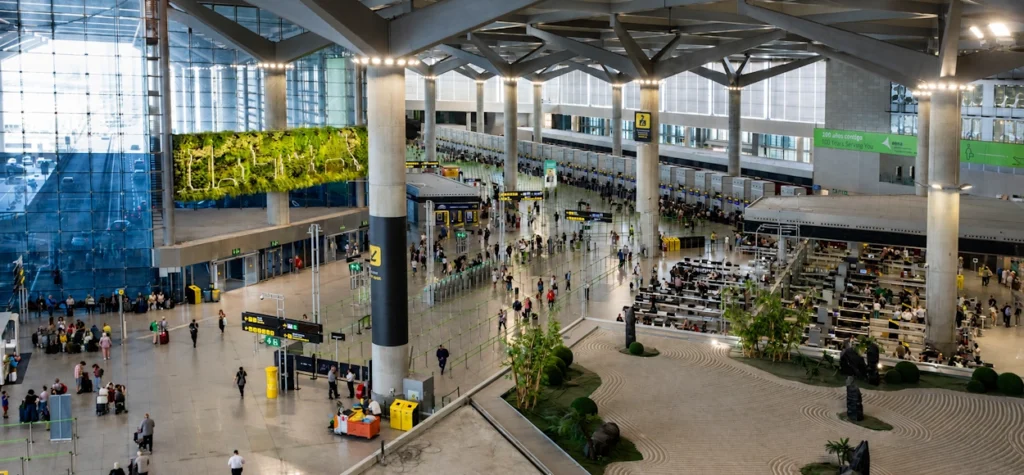
The Costa del Sol This is an excellent example. Málaga-Costa del Sol Airport closed 2025 with more than 26.7 million passengers, 7.4 million more than the previous year. Of these, more than 22.2 million were international connections.
This is complemented by a network that currently reaches 166 destinations, according to the schedule published by Aena. These figures reflect much more than the success of an infrastructure: they demonstrate the extraordinary degree of international integration achieved by Málaga and its province.
For the Costa del Sol, having solid and diversified connectivity is therefore a strategic asset. It facilitates the arrival of visitors from its main European markets, but also opens the door to new markets from further away and with greater spending potential.
Does better connectivity necessarily mean getting more and more direct routes?
If that were our only goal, we would fall into utopia due to a lack of operators, profitability, and stability of demand.
We must also consider optimizing connectivity at major hubs, ensuring efficient connection times, simple and smooth transit, and appropriate schedules and frequencies. Both are equally important.
Therefore, one of the major challenges of the coming years will be to move from a vision based solely on volume to a strategy based on the value of connectivity.
What exactly does it mean to shift from volume to the value of connectivity?
Not all routes have the same impact. It will be increasingly important to identify which markets offer the greatest potential, which connections can help reduce seasonality, and where opportunities exist to develop new long-haul traffic or improve connectivity through major international hubs.
There's a particularly interesting idea in your reflection: "the journey doesn't end at the airport." What else do we need to understand travel as a complete experience?
Connectivity doesn't end when the plane lands. For the full benefits of tourism to be realized, there must be good integration between the airport, ground transportation, hotel offerings, services, digitalization, and the overall destination experience.
Competing for the traveler of the future means offering them a consistent experience from the moment they start planning their trip until they return home.
Given this scenario, what are the main obstacles that could affect the development of aviation in the coming years?
The availability of aircraft and engines, airport capacity, airspace management, the costs associated with the energy transition, geopolitical uncertainty, and the need for infrastructure prepared for growing demand will shape the evolution of the sector.
But precisely within these challenges also appear great opportunities: to innovate, to cooperate better and to build more efficient growth models.
If you had to summarize in one idea where we are headed, how do you envision the future of aviation and its relationship with tourism?
The future of aviation will be technological, sustainable, and increasingly customer-centric. But above all, it will remain a future based on connection: connecting cities, businesses, cultures, families, and opportunities.
For destinations like the Costa del Sol, strengthening this connectivity is not just a matter of transportation. It is a strategy for tourism, economic, and social competitiveness.
In the coming years, destinations that best understand this reality will be better prepared to compete in a global market.
Because, in tourism, being well-connected means being closer to the world. And, in a scenario of increasing competition between destinations, that proximity can make all the difference.
You have professionally experienced several decades of transformation in aviation. Looking back, what change would you find most difficult to imagine for the Víctor Moneo who was starting his career in the sector?
Indeed, there have been many changes; I would say the sector has been completely transformed, although without losing its essence. Digitalization has been a key driver of change, as have all the sustainability measures airlines are adopting, the crucial role of travel agencies with their increasingly prevalent multichannel approach, new distribution methods and, therefore, the modernization of GDSs, the greater expertise of travelers, and, most recently, AI, whose impact we are beginning to see in a very significant way.
You've worked in many different areas: agencies and tour operators, airports, sales in Spain and Latin America, alliances, and now, the global responsibility for Sales and Strategic Agreements. What has this journey taught you about people and how to do business?
I've been incredibly fortunate, and I'm very proud of it, to have had the opportunity to experience different and diverse areas of Iberia, each of which has contributed significantly to the overall experience. In Sales, I learned how to compete fairly with other companies and maintain excellent relationships with travel agencies for so many years, where each party respected the other's role. In Airports, I gained a deep understanding of the operational side; being on the front lines every day revealed a different perspective on what an airline is all about, one that we in the sales department sometimes don't fully grasp. In Alliances, I discovered the value your partners can provide and the value you can offer them—the famous win-win situation. In short, all of these roles have been very enriching, because the important thing is to always be willing to keep learning and never think you know everything.
After so many years involved in aviation and tourism, what continues to excite you about this sector?
I think those of us who work in this sector are very fortunate; I don't know anyone who complains about their job or the satisfaction it brings. I'm still passionate about being able to contribute to a vacation getting off to a good start, to help a company make its travel policy more efficient, to reunite people who haven't seen each other in a long time, to connect different regions, and, humbly, to do my part in the richness and value that this represents.
And finally: when we put aside Iberia, the planes, the routes, and the airports, what is Víctor Moneo like? What things do you enjoy at the end of the day?
Family and friends. Sharing good times with them is essential for feeling well, balanced, and in good spirits. I'm a very normal, fun-loving guy who enjoys traveling, reading, exercising, and having good conversations with diverse people.
I believe that being a positive person is fundamental to being happy and contributes to the well-being of those around you. There aren't many other secrets.