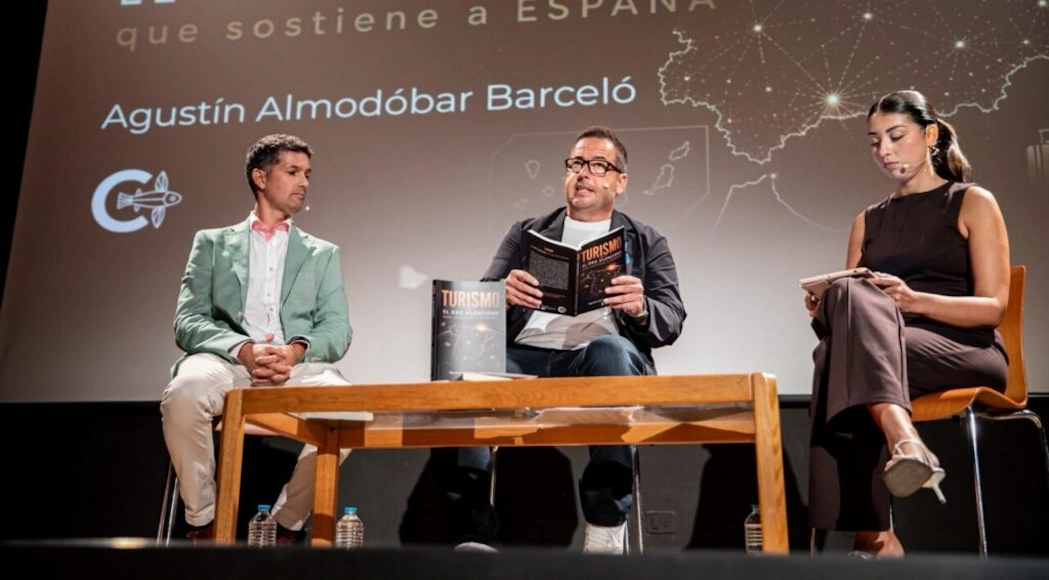


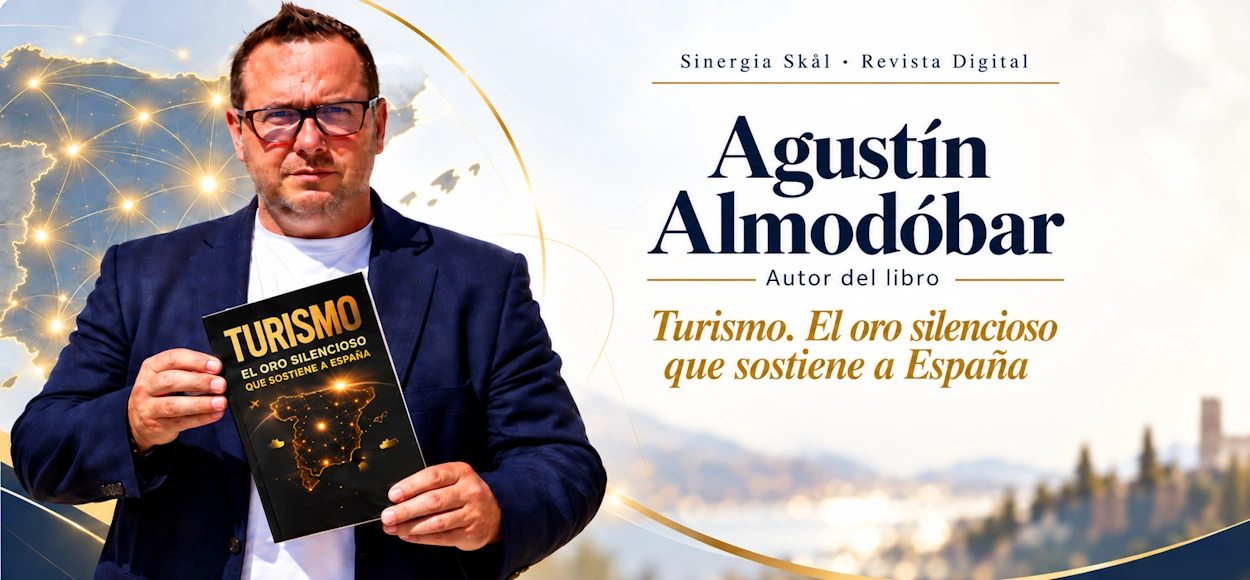
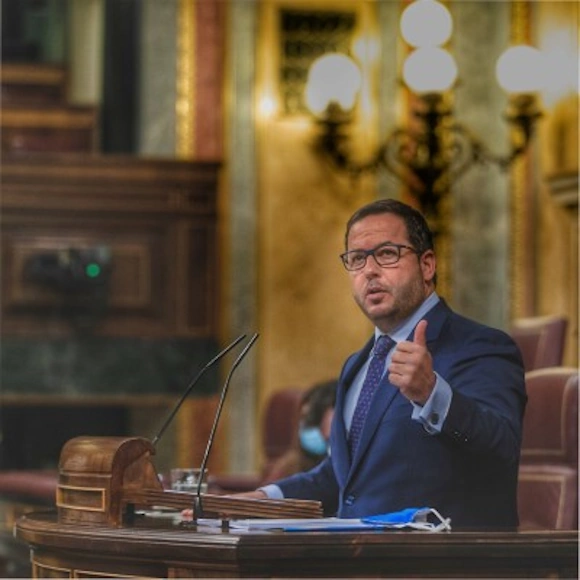
Agustín Almodóbar Barceló has a rather unusual perspective on tourism. He grew up in a family of hoteliers in Benidorm, trained in tourism management and has been championing the sector in the Spanish Parliament for many years. He is currently a senator and the spokesperson on tourism for the Committee on Industry and Tourism.
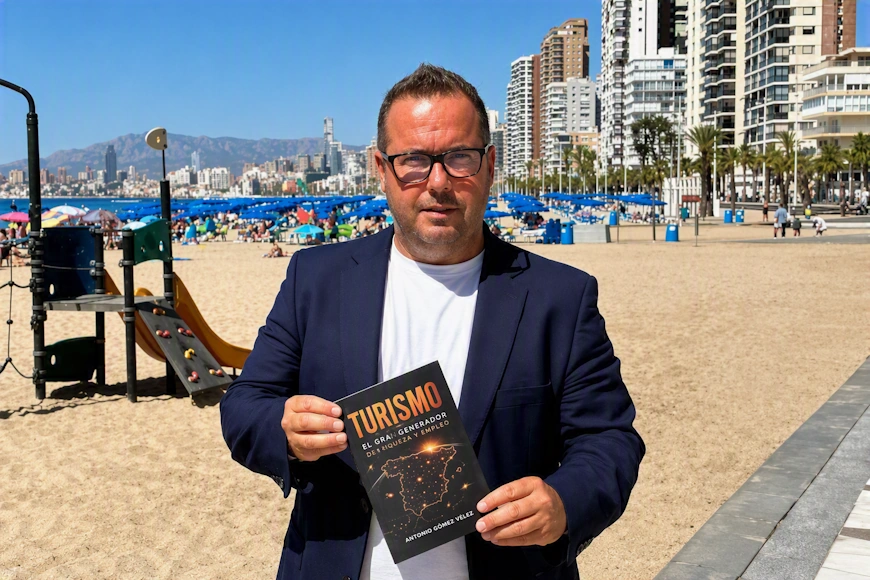
To coincide with the publication of his first book, Tourism. The silent gold that sustains Spain, chat with At Sinergia Skål, about the true value of this sector, trends in tourist destinations, talent, artificial intelligence and the decisions that will shape the competitiveness of Spain’s tourism industry over the coming years.
Agustín Almodóbar and the future of Spanish tourism
1. Your first book is called Tourism. The silent gold that sustains Spain. Why did you choose that phrase, and what aspect of Spanish tourism did you want to highlight?
Because I think it captures a Spanish paradox very well. We are one of the world’s leading tourist destinations, and yet we are not always fully aware of just how much tourism means to our country.
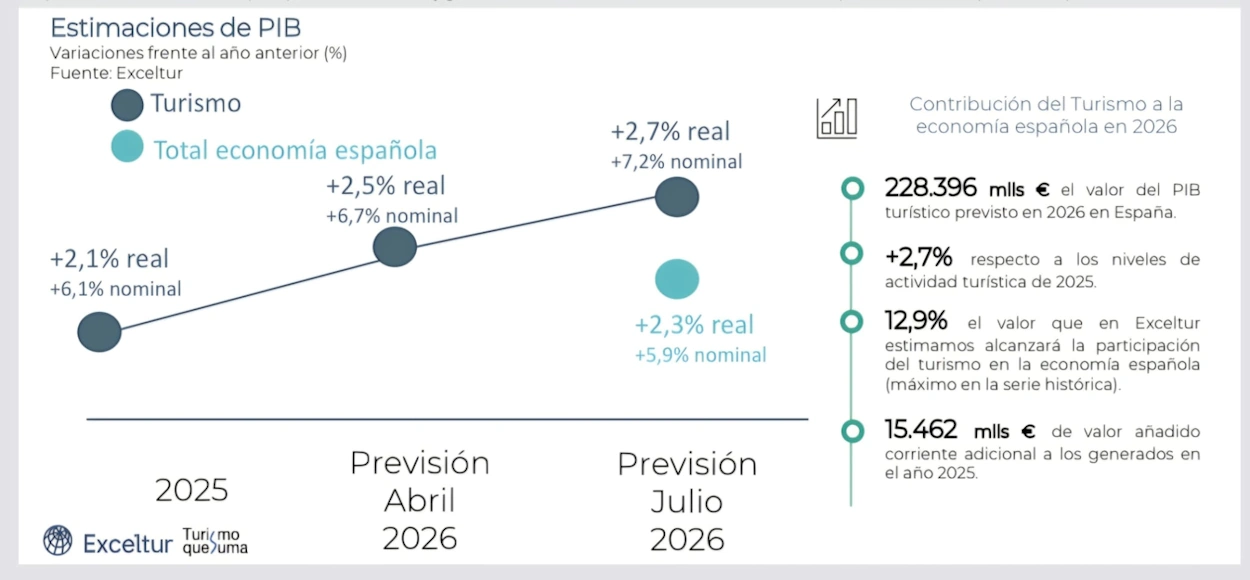
I call it “gold” because it generates wealth, jobs, opportunities, investment, connectivity and territorial cohesion. Tourism accounts for around 13% of GDP and generates millions of jobs, but its true significance goes far beyond the statistics: it has helped to modernise Spain, open it up to the world, transform cities and regions, and create opportunities for entire generations.
And it is “silent” because much of that history has never been told as it deserves to be. Behind Spain’s success in tourism lie entrepreneurs who took risks, workers who turned hospitality into a profession, families, travel agencies, hotels, transport providers, restaurateurs, destinations and public authorities.
I wanted to explain that Spain did not become a global tourism powerhouse by chance. It is a story of collective success built up over generations. Understanding this also helps us to face the future, because Spanish tourism cannot simply content itself with managing the success it has inherited. We have a duty to build the next one.
2. Spain has been one of the world’s leading tourist destinations for decades. What are the strengths that account for this position, and which ones do we all too often take for granted?
Spain offers a combination that is hard to replicate: climate, heritage, culture, cuisine, beaches, natural beauty, major cities, safety, infrastructure, connectivity and enormous diversity, all concentrated within a relatively small area.
But I believe that our main competitive advantage lies in our people. We have an extraordinary culture of hospitality and a business sector that has been competing, innovating and adapting for decades. This ranges from large hotel chains that are now international leaders to thousands of SMEs and self-employed people who sustain the tourism experience on a daily basis.
We also take our accumulated knowledge for granted. Spain has been managing millions of visitors and adapting to changing markets for over half a century. That journey has created a body of tourism expertise that cannot be improvised or achieved overnight.
The problem with major successes is thinking that they are irreversible. They are not. Other countries are investing enormous resources in infrastructure, promotion, technology and new products. Spain is in a privileged position, but having led for decades does not guarantee that it will lead in the next one. Our greatest threat would be complacency.
3. For many years, we have measured the success of tourism by the number of visitors. Which indicators provide the best way of assessing the health of a destination, and what does generating more value actually mean?
For a long time, we used to ask: “How many tourists have come?” Now we must ask a more interesting question: “What value has tourism generated?” Visitor numbers remain important, but they can no longer be the sole measure of success.
We need to measure average spending, business profitability, length of stay, the number of jobs created and their quality, productivity, seasonality, the geographical distribution of visitor flows, investment, connectivity and visitor satisfaction. We must also take into account residents’ perceptions and quality of life, and gain a better understanding of how much of the value generated remains within the region.
A truly successful destination is not simply one that attracts large numbers of visitors, but one where tourism generates prosperity, creates opportunities, preserves heritage and ensures that those who live there want to continue doing so.
Creating value does not necessarily mean charging more, but rather ensuring that what we offer is perceived as better. A hotel does this when it personalises its service and ensures its staff focus on tasks that add human value. An agency does this when it moves beyond simply acting as an intermediary to provide advice, make recommendations and solve problems. And a destination does this when it improves its public spaces, transport links and its cultural, gastronomic or commercial offerings.
Spain should not get caught up in a race to be the cheapest destination. We must compete on the basis of offering greater value. This enables us to improve margins, wages, investment and quality, and reduces our reliance on volume. The aim cannot simply be to fill up hotels, but to generate greater prosperity from every visitor who chooses to come here.
4. You grew up in a family with links to the hospitality industry, in a destination such as Benidorm. What lessons continue to shape your understanding of tourism, and what can its evolution teach other established destinations?
Probably almost everyone. I didn’t first come across tourism at university or in an office, but by watching my family work and growing up in Benidorm. Academic training, professional experience and tourism policy came later, but that early learning experience continues to have a profound influence on my understanding of the sector.
I learnt that behind every room, every table and every booking there are people at work, and that hospitality demands professionalism, hard work and a commitment to service. I also learnt something essential: success in tourism is never a foregone conclusion. A guest who trusts you today may choose another establishment or any other destination in the world tomorrow. This constant competition means we must listen, invest, innovate and never rest on our laurels.
Benidorm proves that a mature destination does not have to be an ageing one. For decades, it has been modernising its hotel facilities, incorporating technology, improving public spaces and managing a huge volume of tourism within a very compact urban layout. This layout reduces the need for travel, optimises infrastructure and enables public services to be delivered more efficiently.
But there is another important lesson: Benidorm has never apologised for being a tourist destination. Tourism is part of its identity, and a significant section of society understands that the city’s prosperity depends on remaining a competitive destination. That does not mean shying away from addressing problems, but rather tackling them with an informed approach rather than rejecting the industry outright. Maturity should mean experience, not complacency.
5. Businesses need qualified professionals, but many struggle to attract and retain them. Where does the problem lie, and are we training the sort of people the tourism sector will need?
This is one of the major challenges of the coming decade. For far too long, we have talked about tourism as a people-centred industry, but we have not always translated that idea into the way society perceives the professions within it.
We need to raise the profile of careers in tourism, improve training, promote the sector and develop attractive career paths. We must explain, particularly to young people, that tourism offers opportunities for growth and specialisation within an increasingly innovative and technology-driven industry.
The problem, however, cannot be analysed solely from an employment perspective. There are places where a worker can find a job but cannot afford a home. Access to housing, mobility, rising costs and employment taxation directly affect the sector’s ability to attract and retain talent.
The tourism sector will need hybrid profiles: professionals who understand hospitality and technology, business management and data, sustainability and profitability, languages, marketing, artificial intelligence and customer experience. This does not mean that everyone must become a technologist, but rather that technology will be integrated into virtually every profession.
We need a much closer relationship between business, universities and vocational training, as well as more dual training and lifelong learning. Many of the professionals we will need in 2035 are already working today. And studying tourism must once again be seen as an excellent career choice. If we are a global tourism powerhouse, our training centres should also aspire to be a benchmark.
6. Artificial intelligence, automation and data are transforming the tourism industry. Where do you see the opportunities, and which part of the experience should retain its human touch?
Artificial intelligence is set to profoundly transform the tourism sector because few other sectors generate as much data or rely so heavily on understanding the customer. We will see it used in demand forecasting, revenue management, personalisation, energy efficiency, translation, customer service, travel planning, mobility and crowd management.
For SMEs, this could lead to a genuine democratisation of technology. Tools that were previously only available to large companies are now becoming accessible to much smaller businesses.
But there is a line we should not cross: we can automate processes, but we must not automate hospitality. A machine can check someone in, translate a hundred languages or recommend a restaurant. Welcoming someone, understanding an exceptional situation, building trust or making a person feel welcome still involves a huge human element.
The technological paradox is that the more automated the journey becomes, the more valuable human contact will be when it is truly needed. The best technology in the tourism sector will be that which frees people from repetitive tasks so that they can spend more time with other people.
7. Travellers are increasingly well-informed and have new tools at their disposal to organise their trips. How will the relationship between the customer, the travel agency, the hotel, the tour operator and the destination change?
We are moving towards a traveller with extraordinary decision-making capabilities. Artificial intelligence will be able to compare thousands of options in seconds and create fully personalised itineraries. This will profoundly change the role of intermediaries, but it does not necessarily mean that they will disappear. Those intermediaries that do not add value will cease to exist.
Travel agencies have a huge opportunity if they move towards providing advice, specialisation, building trust and managing complexity. Hotels will seek to deepen their direct relationship with their customers; tour operators will continue to provide distribution and products; and destinations will have to learn how to engage with travellers before, during and after their trip.
We will probably move on from searching for holidays to interacting with systems that suggest them to us. In that scenario, having high-quality data, a strong digital reputation, a clear brand identity and the ability to build trust will be crucial. The more information there is available, the more important a time-honoured concept will become: trust.
8. Sustainability, community life, mobility, housing and the carrying capacity of certain destinations are all part of the debate on tourism. How can these challenges be managed without resorting to simplistic solutions?
Precisely by avoiding simplistic explanations. I am concerned that some people have turned tourism into a universal explanation for problems whose causes are far more complex.
Access to housing, for example, cannot be explained solely by tourism. Factors such as insufficient supply, regulation, land availability, construction costs, population concentration and labour mobility all play a part. The same applies to the overcrowding of certain areas: often the problem is not one of excessive tourism, but rather of spatial or temporal concentration and poor management.
And here I do believe that, in recent years, the Government has helped to fuel a misleading narrative. Spain cannot celebrate every record number of arrivals in the morning and then, in the afternoon, portray tourists as a problem. That contradiction ultimately damages our reputation, legal certainty and business confidence.
We need professional management: real-time data, planning, mobility, regional diversification, seasonal adjustment, investment and collaboration with the sector. Sustainability is not about putting up barriers for travellers, but about managing the destination more effectively. And it must be environmental, economic and social. If a measure undermines competitiveness, employment or the business fabric, we can hardly call it sustainable.
9. Spain is competing with destinations that are making significant investments. What priorities should a national tourism policy address, and what role should public-private partnerships play?
Collaboration works when it ceases to be a snapshot and becomes a way of working. The public sector provides regulatory capacity, planning and investment. The private sector knows its customers, takes risks, identifies changes in demand and competes on a daily basis. When both worlds share information, knowledge and objectives, the results are often extraordinary.
This is often hindered by bureaucracy, administrative delays, a lack of continuity and, above all, by regulating without sufficient understanding of the reality faced by those who must subsequently apply the rules. A provision that seems reasonable from an office can become an enormous burden at the reception desk of a hotel, a travel agency, a campsite or any other tourist establishment.
Royal Decree 933/2021, concerning record-keeping and reporting obligations in the accommodation and vehicle hire sectors, is a good example. The sector warned of the practical difficulties and the bureaucratic burden that its implementation would entail. A genuine public-private partnership should prevent such situations. Before regulating, it is essential to listen and understand how a regulation will work once it is published in the Official State Gazette (BOE) and reaches a business.
Ultimately, public-private partnership requires trust: it means viewing tourism entrepreneurs not merely as parties subject to obligations, but as partners who take risks, invest, create jobs and generate prosperity.
As for priorities, the first is investment. Airports, railways, roads, water, energy and digital connectivity are all part of the tourism offering. The second is technology: Spain should aim to become the world’s leading laboratory for smart tourist destinations. We must also focus on talent and productivity, diversification and legal certainty.
We have extraordinary opportunities in cultural, gastronomic, sporting, rural and inland tourism, as well as in conferences, shopping, health, film and water-based tourism. Developing these sectors allows us to better distribute visitor flows and generate activity throughout the year.
Leadership in the tourism sector cannot be maintained by decree. Spain needs a national tourism policy with a ten- or fifteen-year timeframe, agreed upon with the sector and stable enough to withstand political cycles. Tourism is far too important to be left to improvisation or subject to ideological agendas.
10. Looking ahead to 2035, how do you envisage travellers, businesses and Spanish destinations?
I envisage a traveller who is far more independent, well-informed and discerning. They will use artificial intelligence from the moment they start planning their trip right through to their return home, and will expect personalisation, immediacy and a frictionless experience.
Businesses will become more technology-driven and will use data to make decisions that are currently still taken on an intuitive basis. Many tasks will be automated, but human talent will be all the more important precisely in those areas that cannot be automated.
Destinations, for their part, will increasingly be managed as living systems, with information on flows, mobility, consumption and demand available in near real time.
There is one thing that will never change: people will continue to travel for deeply human reasons, such as to discover, to relax, to learn, to celebrate, to reconnect or to share. The means may change radically, but the essence will remain the same.
Spain’s greatest challenge will be to use technology to become more efficient and sustainable without losing what made us a leading tourist destination: our ability to make visitors feel welcome.
11. After a lifetime spent working in tourism, what continues to inspire your enthusiasm for this sector, and what would you like to help improve?
I remain fascinated by its capacity to transform. I have seen what tourism can do for a city, a business, a family and a region. I have experienced it first-hand since I was a child in Benidorm, I have studied it, I have gained an insight into it through the business world, and I have been championing it in the Spanish Parliament for many years.
The more I get to know it, the more convinced I am that in Spain we have not yet fully grasped its true significance. Tourism links the economy with culture, heritage, infrastructure, technology, employment, the environment, mobility and our global standing.
That’s why I wrote Tourism. The silent gold that sustains Spain. I felt that we should celebrate a success story of which Spain can be justifiably proud.
I would like us to stop treating tourism as a short-term activity and start viewing it once and for all as a matter of state policy. Professionals should feel proud to work in the sector, business owners should find a favourable environment in which to invest, destinations should have the resources to manage their success, and residents should see the prosperity it generates.
Spain has won over the world with its tourism. The challenge now is to know how to value, look after and improve what we have built. Because tourism is not just one of our main industries. It is one of Spain’s great success stories.