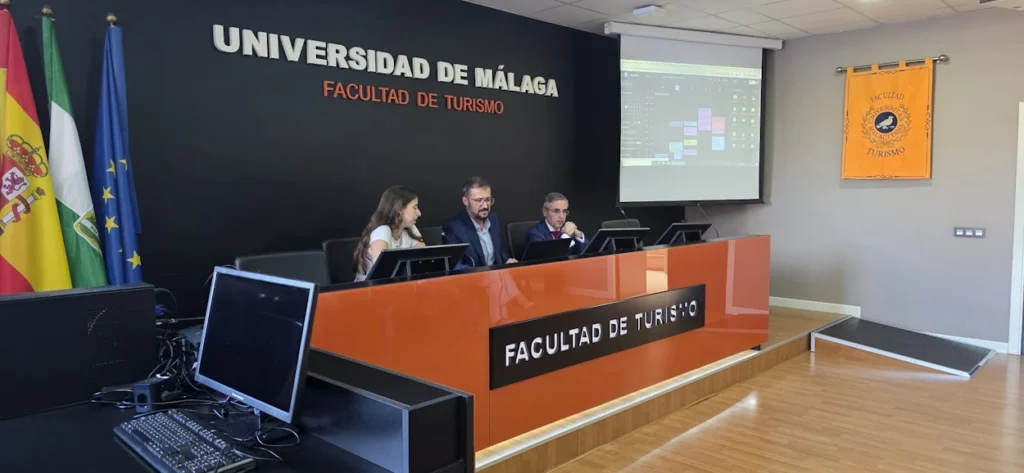




AI in travel agencies is already transforming the way people find inspiration, plan and prepare for their holidays. Data from ObservaTUR and real-world experience at the counter show, however, that artificial intelligence is no substitute for professional judgement, feasibility or trust.
AI is already part of the journey
Artificial intelligence is no longer just a promise for the future; it has become a tool that shapes the way many travellers search for information, compare options and start planning their holidays. But it is one thing to use it, and quite another to hand over the decision-making entirely to it.
The data provided by Marcos Franco, from ObservaTUR, clearly illustrate this gap. Half of Spanish travellers have used generative artificial intelligence for their trips over the past year: 32 % do so occasionally and 19 % do so frequently. Among those who use it, 88 % rate the experience as good or very good, particularly when it comes to comparing prices and planning itineraries.
However, when the question changes to ask how far they would be prepared to delegate, the picture is quite different. Only 15 % would allow artificial intelligence to search for and book the entire trip; 39 per cent would accept this, provided they could review the options beforehand; 34 per cent prefer to retain control; and 9 per cent would opt straight away to speak to a human adviser.
“Eighty-eight per cent satisfaction and fifteen per cent delegation – and that gap isn’t down to technology; it’s down to trust,” sums up Marcos Franco.
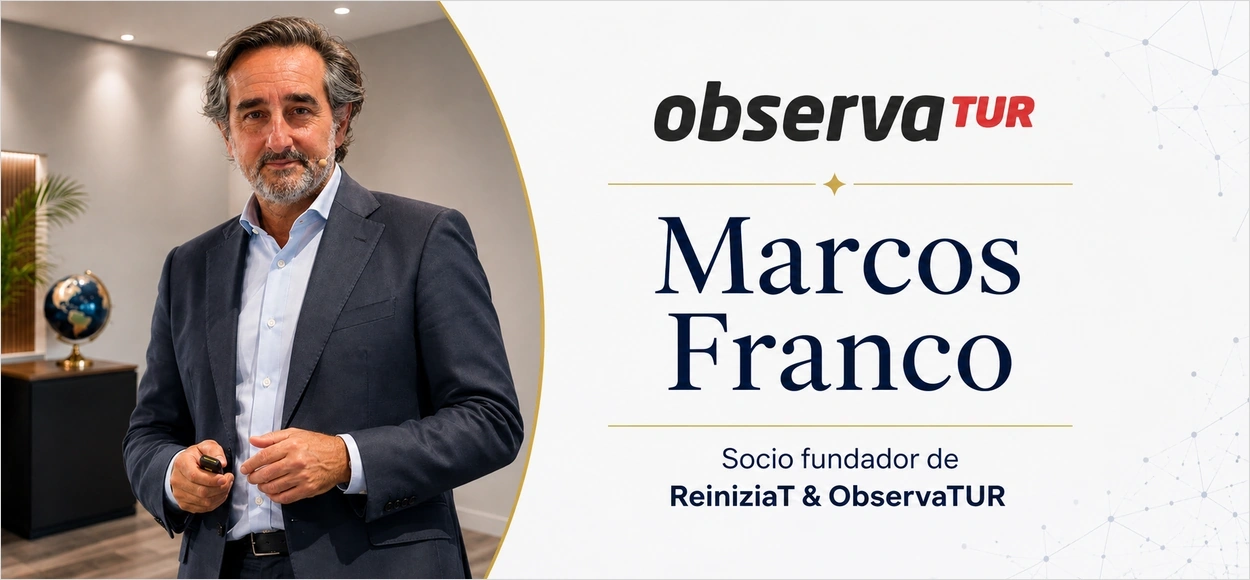
Marcos Franco, founding partner of ReiniziaT and ObservaTUR.
From inspiration to reality
Gustavo Vallecillos’s experience at Viajes de Película confirms that this new trend is already making its way to the counter. More and more customers are turning up who have used artificial intelligence tools to find out about hotels, destinations, places to visit or possible itineraries.
But there is still a significant gap between a convincing portrayal on screen and a journey that is actually possible.
Vallecillos explains that some customers arrive with AI-generated itineraries that subsequently prove difficult to implement because they do not take into account the actual transport operations, the time required or certain economic criteria.
This is where a function comes in that technology cannot yet fulfil on its own: turning an idea into a viable journey. The agency reviews the itinerary, amends routes, adjusts services and, where necessary, calls on local operators who really know the destination.
Other travellers take it a step further. They have designed the overall structure of their trip themselves, but turn to a travel agency to book hotels, transfers, tours and other services that will enable them to bring to life what they have found or planned with the help of AI.

Gustavo Vallecillos, from Viajes de Película.
The agency isn’t disappearing: its value is changing
AI in travel agencies does not seem to be driving travellers away from professional advice; rather, it is changing when and how they seek it.
According to ObservaTUR data provided by Franco, 35 per cent of travellers prefer to use a travel agency, exactly the same percentage as the previous year. Among those who have booked through one, the rating stands at . 8.6 out of 10.
Nor is there any evidence to support the idea that younger people have turned their backs on professional advice. Among travellers aged 18 to 34, 36 % prefer a travel agency, which is virtually in line with the overall average. Interestingly, the age group showing the lowest preference is the 50–64 age group, at 28 %.
The explanation may lie in the fact that the role of the professional is changing.
Whereas previously a large part of its value lay in accessing information and putting together a proposal, today that initial layer can be generated by a machine in a matter of seconds. What is scarce is now something else: validate, correct, adapt to reality and take responsibility when the journey is complex or there is a significant financial risk.
Vallecillos sees this particularly with package holidays or destinations such as Japan, where many services are involved and the total cost can be high. In such cases, he points out, customers look for a high-street travel agency because they want to minimise the risk of making a mistake and have someone to turn to if a problem arises.
AI in travel agencies: from tool to professional support
The transformation is not limited to travellers. AI in travel agencies is also becoming part of the day-to-day work of the professionals themselves.

Artificial intelligence is already an integral part of travel planning, whilst the agency provides expertise, feasibility assessments and professional support.
Franco points out that the use of artificial intelligence across agencies has moved from 40 % to 61 % in one year. And the most significant growth is not limited to occasional use: regular use has risen from 12 % to 27 %.
It is interesting to see what it is being used for.
Among the agencies already using AI, 78 % use it to generate content and text, and 51 % to prepare personalised recommendations. By contrast, virtual assistants and chatbots account for just 18 %.
The trend suggests a very specific model: Technology is being introduced mainly behind the counter, to improve processes and boost efficiency, whilst the relationship with the customer remains fundamentally human. This idea ties in with a point we have already discussed at Sinergia Skål: Tourism remains a people-centred business.
At Viajes de Película, the view is also positive. Vallecillos says that working with artificial intelligence is proving to be a valuable aid to them. He does not see it as a threat, but rather as a tool capable of enhancing the agency’s work when used judiciously.
Planning is easy; taking responsibility for the decision is another matter
If we analyse the entire travel process, artificial intelligence already plays a significant role in the early stages.
For Franco, the shift towards inspiration and planning has already taken place: this is precisely where travellers most frequently turn to these tools, both to compare prices and to plan their itineraries.
One of the current limitations of AI in travel agencies relates to the booking process.
This is when money, dates, connections, booking terms and the possibility of something going wrong all come into play. And at this point, the traveller is no longer just looking for an appealing recommendation, but for peace of mind.
In his view, personalisation represents one of the areas with the greatest potential for growth for agencies, as it enables technology to work for the professional rather than against them. 51 % of agencies using AI already employ it to prepare personalised recommendations.
In-flight assistance, on the other hand, is the area where there is still the most room for improvement. When an incident occurs – such as a missed connection, a cancellation or an unexpected change – the solution often still involves a phone call and a person’s ability to take charge of the problem and resolve it.
Travellers are better informed, but not necessarily safer
New customers no longer necessarily walk into a travel agency asking where they might go on holiday.
You may arrive having already decided on a destination, with an itinerary suggested by a tool, several accommodation options and a fairly clear idea of what you want to do.
The use of AI in travel agencies is forcing professionals to adapt. It is no longer enough simply to have information: they must interpret it better than the customer, spot errors, anticipate problems and come up with solutions that the tool has not considered.
Franco sums it up with a particularly significant idea: putting together the proposal is no longer the hard part. The hard part is to validate it, correct it and make it a reality, and, above all, that someone takes responsibility for that decision when the journey is complex or the customer perceives a risk.
Vallecillos adds another very vivid perspective: “Technology is still in its infancy, and only a tiny fraction of travellers are fully familiar with it”.
Customers continue to demand speed and expertise, but they also want someone to take care of their holidays. In the business sector, moreover, the reliability and accountability of a travel agency remain key factors.
Technology in the background, people at the forefront
The debate on AI in travel agencies, therefore, does not seem to be about whether it will replace professionals, but rather how their work will change and where its true value will lie..
The data suggests that travellers are becoming increasingly open to technology, but they remain reluctant to delegate important decisions to it.
Agencies, meanwhile, are beginning to use AI to produce content, personalise recommendations and improve efficiency, but they are not yet using it to replace personal contact.
That balance can become an advantage: AI in travel agencies brings speed and analytical capabilities, whilst the professional retains their judgement, responsibility and personal touch.
Professionals who simply compete on the basis of speed or the volume of information will find it increasingly difficult. On the other hand, those who manage to use technology to work more effectively and free up their time for tasks that require experience, judgement and responsibility can strengthen their position.
“The professional who comes out on top will not be the one who competes using the tool, but the one who lets it do the work in the background whilst they focus on what it cannot cover: judgement, trust and personal touch,” concludes Franco.
Artificial intelligence is changing the way we plan and organise a trip. But when the time comes to turn a plan into a real-life experience, take risks and deal with things if something goes wrong, Trust still comes down to people..