

From verdiales to concert halls, from flamenco to emerging artists, music is part of a way of understanding Málaga that goes far beyond its monuments, beaches and cuisine. A destination can also be discovered through the sounds it produces.
Some cities are recognised by their skyline. Others by a scent, a square, a traditional dish or a particular way of experiencing street life. Málaga has all of these, but it also has a soundscape that has been an integral part of its identity for generations.
Verdiales, flamenco, marching bands, singer-songwriters, venues, festivals, open-air concerts and an ever-evolving arts scene are all part of a city that can also be explored through your ears.
Musical culture is not simply entertainment. It can become a memory, a sense of belonging, and also a different way of experiencing a destination.
A city can also be told through songs
When we talk about a destination’s identity, we tend to think of historic monuments, museums, cuisine or the landscape. But music can convey the essence of a region with a depth that is hard to achieve through a conventional guidebook.
A song can transport us back to a neighbourhood. A particular rhythm can be the hallmark of a celebration. A venue can form part of the memories of several generations. And an artist can convey, beyond the confines of their city, a way of speaking, of feeling or of looking at the world.
Kanka makes this clear in his interview with Sinergia Skål: creative expression shapes identity, and music is probably its most popular and widespread manifestation.
His own career demonstrates the extent to which his roots can coexist with the influences he has absorbed whilst travelling. Málaga and Andalusia remain evident in his artistic expression, whilst Latin America has broadened and enriched part of his musical language.
It is not a question of turning local culture into a static postcard, but quite the opposite: maintaining a recognisable identity whilst incorporating new perspectives.
Verdiales: when music is part of the land
Few forms of expression illustrate the relationship between music and place better than the verdiales.
They are not simply a musical genre. They embody celebration, community, dance, traditional dress, instruments, territory and the passing on of traditions from one generation to the next. The Regional Government of Andalusia recognises the Fiesta de los Verdiales as an Asset of Cultural Interest, within the category of Activity of Ethnological Interest, according to the available official information. It is advisable to consult the current official record to ascertain the geographical scope and the exact date of the declaration.
The exhibition The festival: Verdiales from Málaga The exhibition **The festival: Verdiales from Málaga** is scheduled to take place between 15 October 2026 and 14 March 2027. As this is a future event, the dates, venue, programme and visiting conditions should be verified with the organising institution’s official source prior to their final publication. The exhibition offers an overview of its origins, its institutionalisation from the 1960s onwards, its period of expansion and its current status; this information should also be cross-checked against the exhibition catalogue or official press release.
It is a good example of how a traditional event can cease to be viewed solely as folklore and instead become a cultural narrative of a region.
Because getting to know the verdiales means getting to know the Montes de Málaga, its festivals, its communities and a way of experiencing music that was not created for a tourist audience, but within the very society that keeps it alive.
And that is precisely why it holds value for those who visit the province: because it allows them to experience something authentic that existed before it became a visitor attraction.
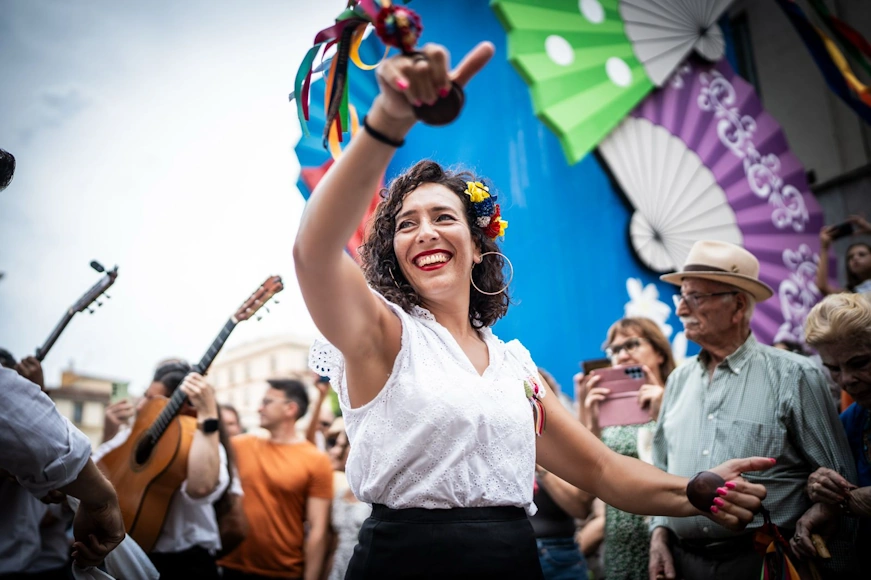
The music comes from the concert halls
Málaga’s musical identity is not confined to large cultural venues either.
The Municipal Band’s programme for the 2026–2027 season comprises around twenty free concerts taking place at various venues across the city. Plaza de Tabacalera, the Santuario de la Victoria, the Málaga Museum, the La Concepción Botanical and Historical Gardens and Gibralfaro Castle are among the venues listed in the programme. The exact number of concerts, whether they are free of charge, and the venues should be checked in the official programme issued by Málaga City Council or the Municipal Band before being publicised as definitive information.
This model is of particular interest from a cultural and tourism perspective: it enables a connection to be made between music and space.
Listening to a concert in just any venue is not the same as doing so in Gibralfaro, in La Concepción or next to a building that forms part of the city’s collective memory. The artistic experience changes and the venue itself takes on a different meaning.
Culture can thus help residents and visitors to see familiar places in a new light.
From flamenco to contemporary art
Nor does Málaga rely solely on its historical musical heritage.
The autumn cultural programme presents Dance Málaga 2026 as a programme bringing together flamenco, contemporary dance, tango, classical repertoire and family-friendly shows, featuring artists such as Sara Baras, Farruquito, Pastora Galván, Luz Arcas, Daniel Doña and Ana Morales. The figure of 18 performances and the participation of each artist should be checked in the festival’s official programme or in the organising institution’s announcement, as these are subject to change.

At the same time, initiatives such as Interritmos At the same time, initiatives such as **Interritmos** are described as support and training programmes for artists working in the fields of music and dance. The organisation responsible, the exact scope of the programme, its calls for applications and the relevant dates are not specified in the text and should be supplemented with the corresponding institutional reference.
These are examples of an important point: a culturally attractive city cannot simply limit itself to showcasing what it already has. It needs to create the conditions for new creative work to continue to emerge.
Heritage lends depth to a destination. Contemporary creativity gives it a present and a future.
The value of live music
In his conversation with Sinergia Skål, El Kanka also raises a less comfortable point. When asked whether cities sufficiently understand the value of live music for their identity and appeal, he considers that in Málaga this remains an unresolved issue and calls for greater attention to be paid to the local scene. This statement should be understood as the artist’s personal opinion, not as a fact that can be independently verified.
This reflection deserves to go beyond any one particular artist.
When a city commits to live music, it is not simply organising concerts. It is supporting venues, technical staff, musicians, promoters, the hospitality sector, transport and a whole small cultural economy that also breathes life into the city. The scale of these effects depends on the context and would require specific economic data to be quantified.
Major events bring visibility, but the everyday cultural fabric is also built through small venues, emerging artists and regular programming.
From a tourism perspective, that difference is significant.
A city may attract visitors because it hosts a major concert at the weekend. But it becomes a true cultural destination when people feel that, whatever week of the year it is, there’s always something going on there.
Cultural tourists are looking for more than just monuments
Contemporary travellers are increasingly less likely to base their experiences on a single attraction. This statement is interpretative and should not be presented as a general trend without being backed up by tourism studies or data on visitor behaviour.
You can visit a museum in the morning, find a traditional restaurant at lunchtime, go for a walk around a neighbourhood in the afternoon and go to a concert in the evening. It’s all part of the same trip.
In this context, music can become a gateway to other aspects of the destination.
Anyone who explores the verdiales eventually discovers a whole new world. Anyone who attends a festival gets to know an urban space. Anyone seeking out the music of an artist from Málaga may well end up taking an interest in the places that form part of their imagination.
The interview with El Kanka offers a particularly vivid example. When we asked him where he would take someone who wanted to start getting to know Málaga, he didn’t single out any one major monument. He spoke of eating espetos in El Palo, of the Baños del Carmen, of Casa del Guardia and Casa del Perro, and of climbing up to Gibralfaro to gaze out over the city from above. These are personal recommendations made during the interview, not an official selection nor an objective assessment of these places.
It is a deeply personal selection, but it also explains how our relationship with a destination is often forged: through a combination of places, sounds, flavours and memories.
Culture versus the showcase city
There is also another issue that culture compels us to raise.
Tourism success transforms cities. It can generate economic activity, employment, the regeneration of areas and new opportunities, but it can also alter what initially made the destination attractive. The relationship between tourism, employment, housing and regeneration requires specific local data to assess its effects and cannot be taken for granted in general terms.
El Kanka speaks openly about this tension when referring to Málaga. He expresses concern about the loss of identity in certain areas of the city centre and links this process to the debate on housing and rising rents. These are the artist’s own opinions and perceptions; to confirm trends in rents or their causes, one would need to consult official statistics and specialist studies.
You don’t have to agree with every interpretation to recognise that there is a valid question: How can a destination evolve without becoming a representation of itself?
Culture can be part of the solution.
When local events, artists, small venues, neighbourhoods and traditions retain their place, the city retains the capacity to produce culture, rather than merely to showcase it.
And that can also enhance the tourist experience.
Because visitors looking for culture don’t usually want to find a stage set. They want to immerse themselves, even if only for a few hours, in a city that is still alive.
Listening is also a form of travel
Málaga boasts museums, historical heritage, a coastline, gastronomy and an extraordinary ability to attract visitors. Any assessment of this ability should, if presented as data, be based on official tourism statistics. But its identity does not end there.
It’s also in a verdiales group.
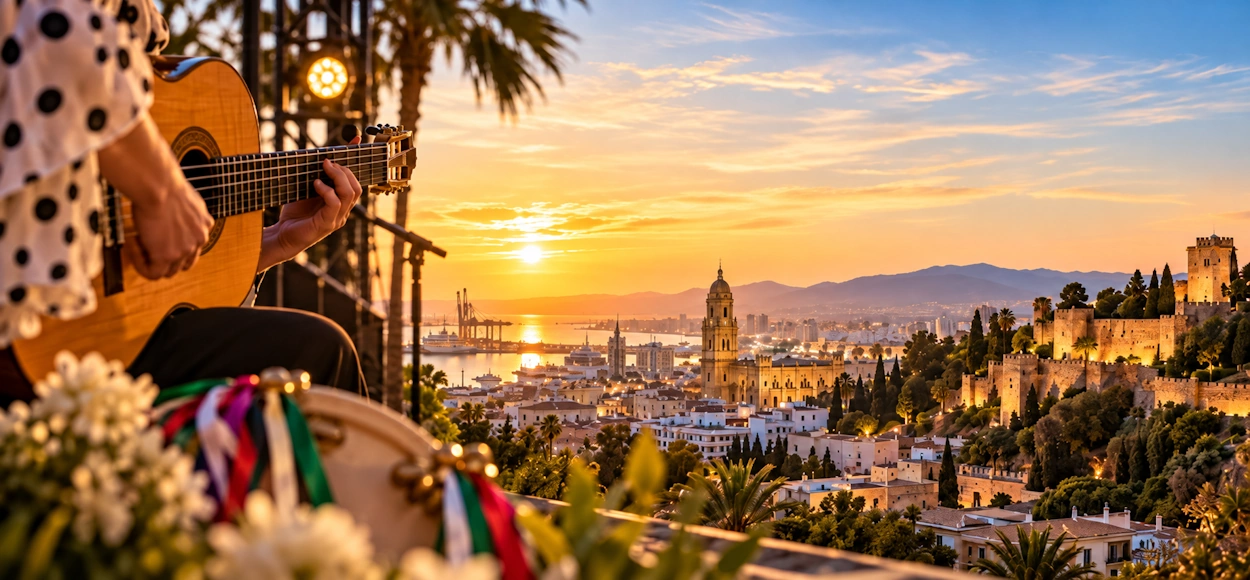
A guitar on stage.
In a band playing outdoors.
In a small room.
At a festival.
An artist who brings his accent and cultural references to stages across other continents.
And in the songs that later return with him.
Perhaps getting to know a destination properly is precisely about that: stopping for a moment to look beyond just what we’ve been told to photograph, and starting to listen as well.
Because Málaga is heard too.