
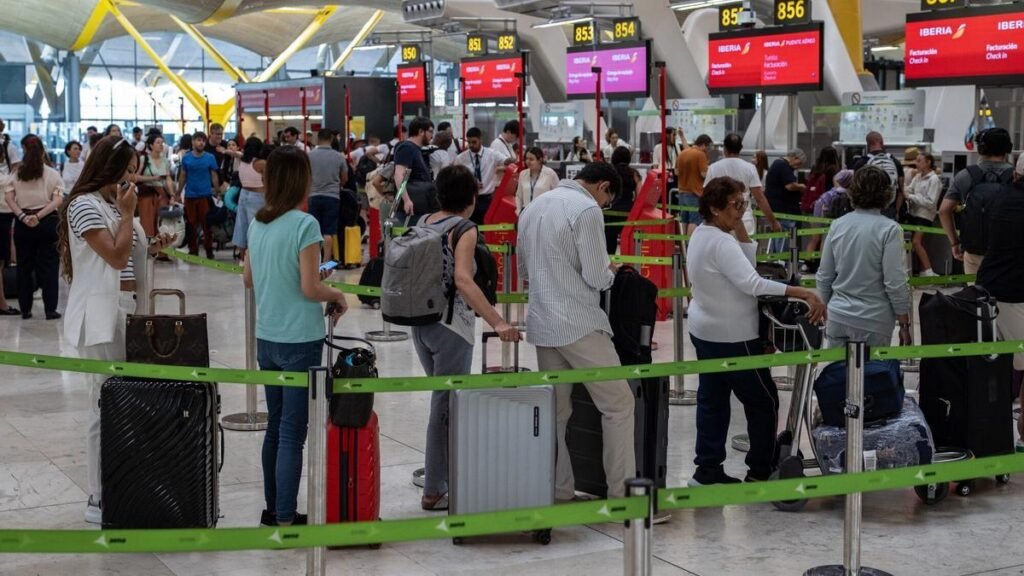
Aena’s Spanish airports handled 287,738,159 passengers between January and October 2026, a 4 per cent increase on the first ten months of the previous year. This increase underscores the importance of air connectivity to the tourism sector, although growth rates vary across different destinations.
According to the official report published by Aena on 12 November, the Spanish network recorded 2,408,683 aircraft movements between January and October, 4.4 per cent more than in 2025. Freight traffic totalled 1,111,946 tonnes, down 0.4 per cent year-on-year.
October sees more than 30.5 million passengers
In October, Spanish airports recorded 30,523,291 passengers, up 3.5 per cent compared with the same month in 2025. A total of 255,205 transactions were carried out (+3.9 per cent), whilst the volume of goods fell to 121,956 tonnes (-9.9 per cent).
The figures confirm that air traffic continues to grow after the summer. However, the rise in passenger numbers should not automatically be interpreted as a corresponding increase in tourist spending: these are different indicators and are driven by different factors.
Málaga Airport has seen growth of 6.4 per cent, exceeding the national average
In Andalusia, the following stands out: Málaga-Costa del Sol Airport, which handled 24,826,892 passengers between January and October, 6.4 per cent more than in the same period the previous year. During those ten months, 169,422 flights were recorded.
The international market is a key factor in this trend. Of the 24,793,938 passengers on commercial flights, 20,840,422 travelled on international routes, representing a 7.2 per cent increase. Domestic flights carried 3,953,516 passengers, an increase of 2.7 per cent.
In October alone, Málaga recorded 2,696,944 passengers, up 4.7 per cent in the same month of 2025, a figure that highlights the dynamism of the Costa del Sol’s tourist connectivity.
Connectivity and tourism planning
For hotels, travel agencies, tour operators and inbound tourism companies, these figures provide a key indication of the volume of traveller traffic and the opportunities generated by air routes. At the same time, this growth requires attention to be paid to the quality of services, ground transport links and coordination with other modes of transport.
Tourist mobility does not depend solely on the number of available airline seats. Connections between airports, cities and final destinations are also important. In this regard, Sinergia Tourism recently published a report on Iberia’s increase in flights to Andalusia in light of the difficulties facing the high-speed rail service, an example of the importance of complementarity between different modes of transport.
Spanish airports: connectivity and growth in tourism
Passenger figures also raise a question for Spanish destinations: how to turn the increase in air links into a higher-quality tourist experience and opportunities spread throughout the year. A diverse range of options, clear information for travellers and effective links with public transport can help ensure that the benefits of connectivity reach more areas and businesses.
The cumulative figures up to October provide a useful benchmark for identifying trends, but they must be analysed alongside other indicators, such as hotel occupancy, visitor spending, the length of stays and the geographical distribution of arrivals. Airports are a key gateway, but not the only indicator of success in the tourism sector.
A positive assessment that requires us to look beyond the figures
The 4 per cent growth recorded up to October means that Aena’s Spanish network is on track to reach nearly 288 million passengers before entering the final two months of the financial year. The figure reflects the strength of demand for travel, but its impact on each destination will depend on source markets, routes, seasonality and the ability to transform those arrivals into sustainable economic activity.
Málaga’s growth, which exceeds the national average, confirms the strategic importance of its airport for tourism in Andalusia. The challenge will be to ensure that the increase in traffic is matched by infrastructure and services that meet the needs of travellers and residents.
Sources: Aena, official statistics for October 2026 y Nexotur.