



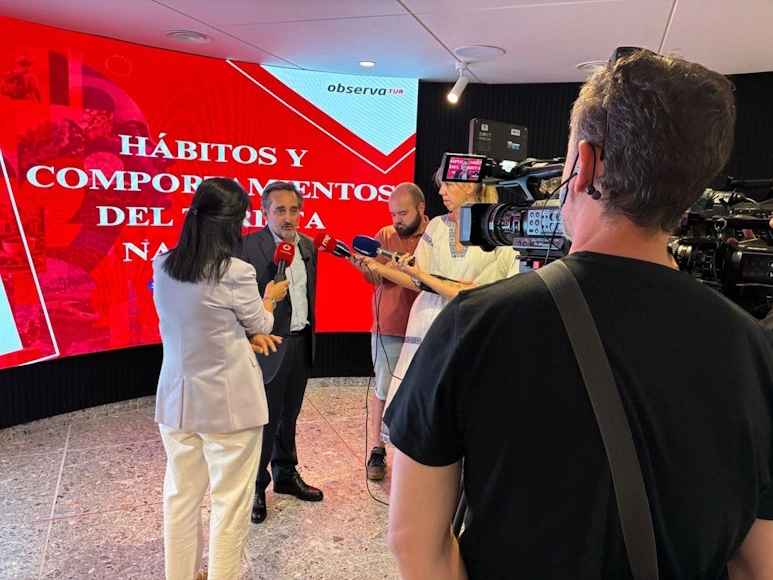
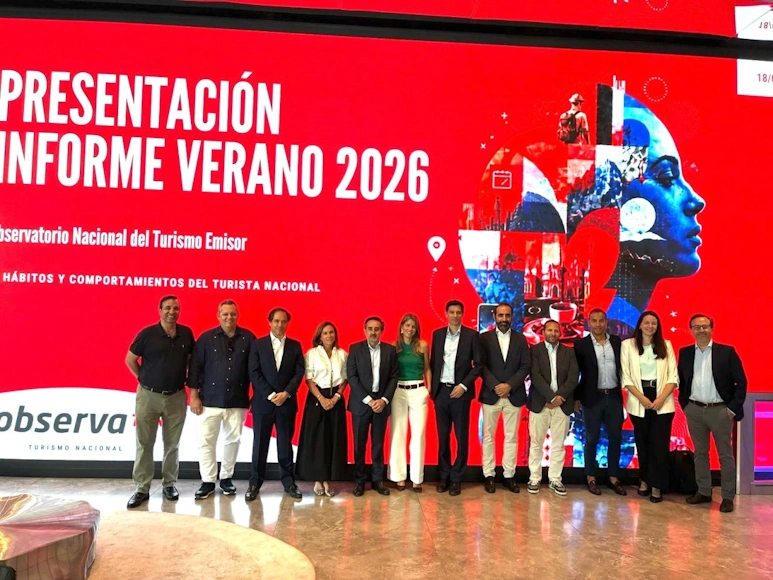
The fact that Skål is launching a magazine with the aim, amongst other things, of sharing knowledge within the sector is undoubtedly good news for the industry, and a mission with which we feel very much aligned. In ObservaTUR We have been following the same approach for eight years, surveying Spanish travellers, travel agencies and our expert panel on tourists’ habits and behaviour. Seventeen survey rounds, in summer and winter, with a core set of questions repeated in each one. When you have accumulated so many years of data on the behaviour of Spanish travellers, you would expect to see a major transformation, but what we have found is something different and, at the same time, far more interesting.
To write these lines we could have done what we usually do, which is a list of the year's trends, but we have preferred to do the reverse exercise, reviewing what the sector, including ourselves, has been announcing for years, and checking it against the historical data series of ObservaTUR.
Let's start with the obvious. The Spanish traveler has changed, and drastically. They are better informed than ever, tech-savvy, seek experiences rather than destinations, and scrutinize every detail to ensure that what they pay for matches what they receive. All of this is true, and we've been saying it for years—we're the first to admit it.
But there's a change that's talked about much less, and which, in our opinion, is the most profound of all. Until not so long ago, when a crisis hit, vacations were the first thing to be cut; demand plummeted, and the industry felt it immediately. In recent years, there's been a pandemic that brought the world to a standstill, a war in Europe, another in the Middle East, and great geopolitical uncertainty, not to mention the highest inflation in three decades. Given this scenario, a drastic drop in demand would have been expected, but it hasn't materialized. The most profound change isn't that travelers want different things; it's that they no longer forgo travel, even when they have every reason to. The old rule that vacations are dispensable when circumstances aren't right has been broken.
When we asked them last May, 89% of Spanish travelers said they planned or considered it likely they would travel this summer. While this is five percentage points lower than the previous year, indicating moderation, it's not a contraction. The average budget per person was €737, practically the same as in 2025, after four consecutive years of increases.
This retrospective exercise also allows us to critique some of the predictions, since we have announced several times that the habits of Spanish travelers would never be the same, and on a few occasions we were wrong. Let's see.
In 2019, Booking.com reported that 85% of Spanish travellers would be more likely to book accommodation if they knew it was eco-friendly, and the sector took it for granted that the sustainability It would be a purchasing criterion. Seven years later, when we asked what drives travel choices, the fact that a destination is sustainable ranked 41st in the list of first mentions. It matters to them, I have no doubt, but what we don’t see is this actually translating into their holiday purchases. Shortly afterwards, it was taken for granted that, following the pandemic, travellers would stay closer to home to a greater extent, and that accurately described a time when half of Europe was closed or subject to restrictions, but the reality is that this trend did not take hold, and by 2025 domestic travel had fallen by 6.1% whilst overseas travel had grown by 5.2%.
It was also announced, quite insistently and emphatically, that travelers would eventually abandon travel agencies and that, therefore, a good number of agencies would close within a few years. Certainly, the disappearance of agencies and distribution in favor of direct sales is something that those of us who are more experienced, like myself, have been hearing about for over thirty years, since the rise of the internet. And for the moment, although there are some nuances, we don't see any signs of that happening. 35% of travelers prefer to use an agency, exactly the same percentage as last year, and those who booked through one rate it 8.6 out of 10.
And here's a common misconception that needs to be debunked. It's often said that younger generations have turned their backs on agencies, but our data tells a different story. Among those aged 18 to 34, 36% (a percentage of those who prefer agencies) prefers working with an agency, practically the same as the average. The segment that least favors agencies isn't this age group, but rather the 50-64 age group, at 28%. These same individuals are also the most forward-thinking and the most inclined towards package deals and all-inclusive options. We tend to assume they're the ones who most want to organize everything themselves, but it turns out that, according to the data, they're precisely the ones who most value having things handled for them.
The most recent and loudest announcement is that artificial intelligence will organize our trips and we'll no longer need travel agencies—we're back to the same argument from decades ago. Here, the data reveals something more nuanced than the headline. Half of travelers have used generative AI for their trips in the last year, and among those who use it, 88% rate the experience as good or very good, especially for comparing prices and planning itineraries. So far, a remarkable adoption rate. Now for the other side. Only 15% would let AI search for and book their trip, 34% prefer to maintain control, and 9% prefer to speak directly with a human advisor.
Eighty-eight percent satisfaction and fifteen percent delegation. That difference isn't explained by technology, it's explained by trust.
And here's my take. I'm convinced that artificial intelligence is going to transform everything—in fact, it already is—and that's precisely why I believe the human factor will become more valuable, not less so. When anyone can ask a machine to create an itinerary for them, planning will no longer be a scarce commodity. What will be scarce is someone with experience to vouch for the decision, especially on complex trips or those where the client perceives risk. The winning formula, at least in the coming years, will be a trusted and expert agent supported by all the tools and processes that AI offers. The best of both worlds. It remains to be seen how all of this will evolve, and I'm convinced that, given the speed of the transformation, in the coming years we'll see things we can't even imagine today.
So, if travelers haven't made sustainability their purchasing criteria, haven't stayed home, haven't abandoned travel agencies, and haven't delegated their vacations to an algorithm, where is the change that should really matter to the industry?
This brings us back to what we pointed out at the beginning: travelers are no longer willing to give up travel. And the best proof that this change is real isn't what they say, but what they're willing to do to avoid missing out on it.
46.1% of travelers would consider financing their vacation if offered reasonable terms, six points higher than last year, and among those under 35, this figure rises to 60.1%. One in three saves throughout the year for the trip, almost as many cut back on other expenses, three in ten look for deals, and nearly two in ten shorten their trips to make ends meet. Only two in ten say they don't need to take any action. The other eight do.
And this has obvious consequences for those who sell travel. If the customer hasn't stopped wanting to travel, but is now figuring out how to afford it, the conversation at the counter is no longer about convincing them to travel, but about helping them make those calculations work out in the best possible way. Payment plans, insurance, the chosen season, or the adjusted duration have ceased to be extras and have become a significant part of the product itself.
The Spanish traveler has indeed changed, and in many ways. But the change that should concern us most is not that they have become more technologically advanced or more demanding; the most relevant change is the shift in priorities, with travel no longer being the first thing to be cut back on, but rather the last.
«"Travel went from being the first thing to be cut to being the last."»