



When the spotlights go out and there's no longer an audience to entertain
I have met Sr. Corrales at various points in my career, and I’ve had the opportunity to work with him at some of our events. I always remember him in much the same way: professional, approachable, quick on his feet and, above all, always ready with a smile at just the right moment.
This time, however, I don't want to interview the comedian, the lecturer, the trainer, the presenter, or the master of ceremonies. Nor do I want to interview the professional accustomed to standing before halls and auditoriums and facing something as difficult as getting hundreds of people to listen, participate, and, moreover, laugh.
By Juanjo Oliván · Sinergia Skål
I want to get to know the person when the lights go out.
To the youngest of a family of ten siblings who dreamed of making people laugh; to the man who has turned an untied tie into part of his identity; to the professional who takes something seemingly as spontaneous as humor very seriously and, especially, to someone who has dedicated a good part of his life to bringing out one of the most universal expressions of all in others: a smile.
At Sinergia Skål, we spoke with Sr. Corrales about his origins, his fears, the pressures he faces, his vulnerability, his silences, his mistakes, and everything else that usually remains offstage. And we inevitably arrived at the question that best summarizes this conversation: who is Corrales when no one expects him to be funny?
You've dedicated a good part of your professional life to making others smile. But let's start from the opposite perspective: what truly makes Corrales laugh when he's not working?
I find humour in the spontaneity of everyday life, unexpected occurrences, and the absurdity in small routines. Ultimately, humour is everywhere if you know how to look for it.
And I'll confess something: I laugh at myself a lot. They say that someone who can admit a mistake with a smile is usually also an intelligent person.

You are the youngest of ten siblings, and you've said that as a child you used to play at acting in front of your family. What remains of that child today, and how much of who you are today truly began in that house?
Almost everything remains, really. In my house we were so poor that instead of silkworms we had corduroy caterpillars.
That child still has the same enthusiasm for capturing attention (being the youngest of ten, you either learn to make yourself noticed or you disappear among your siblings), playing with words (my family was the hardest jury to please) and seeking the complicity of others through a smile.
My home was my first stage and my best school. I learned that to make ten people laugh, you have to know how to "read" ten different people at the same time. Without realizing it, I was already practicing what I do today in front of five hundred.
Do you remember the first time you discovered that making people laugh could be more than just fun and become a way to communicate with others?
More than an exact day, it was a natural process.
When you discover that a good laugh can disarm any tension and create an invisible bridge between people, you understand that humour isn't just entertainment; it's the best communication tool. You gain attention, closeness, and trust.
Humour isn't just for when things are going well; it's even more useful when things are going badly. Humour has an extraordinary ability to generate positive emotions.
I am one of those who think that laughter is the shortest path between people.
We all know Sr. Corrales from the stage. Where does that character end and the person begin? Is there really a boundary between the two?
The boundary is very blurred; it exists, although it is becoming increasingly thin, I admit.
Sr. Corrales is a concentrated version of me with an untied tie: faster, more energetic, more intense, without the silences or doubts that “Corrales” himself has when he gets home. Offstage, I still look for a smile in more intimate conversations, even if sometimes I have to get serious and turn down the volume.
I have never wanted to create a character different from who I am.
The real boundary lies in privacy. On stage, I'm never truly alone; there's always someone expecting something from me. At home, I'm still a curious, observant, hardworking person, and much calmer than people imagine.
Sr. Corrales isn't born when the lights come on. He just shines a little brighter.
There's something that's been with you for years and has almost become your signature: that tie that never quite gets knotted. What does it mean to you, and how much of Corrales is in that small gesture of rebellion?
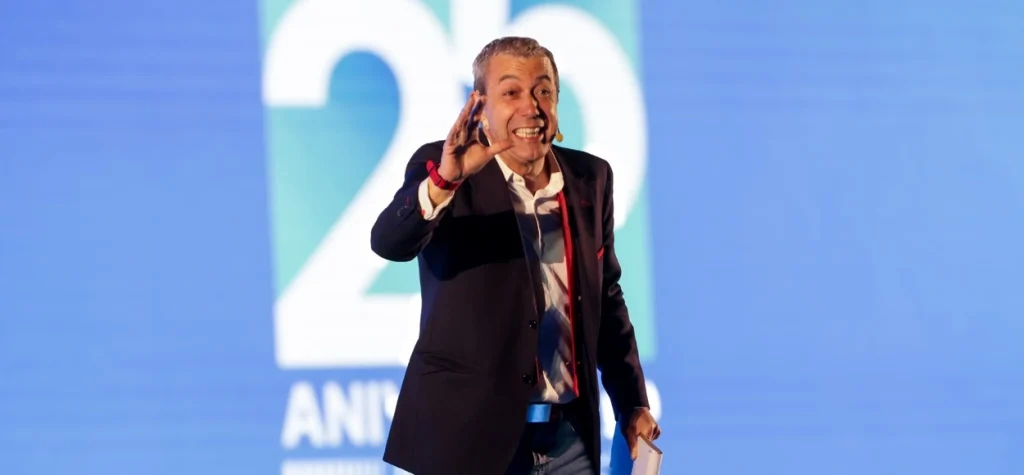
It's my absolute hallmark. I take my work very seriously, but I try not to take myself too seriously.
I haven't tied a tie in over twenty-four years. That undone tie represents elegance combined with approachability, a break from rigidity, and a constant reminder that we shouldn't always take things with such solemn formality.
It's a small gesture, but I stick to it with the same discipline as a motto. My tie reminds me, before going on stage every day, that authenticity matters more than perfection. A perfect knot wouldn't make me a better professional; an untied tie, every day, reminds me who I am before I step on stage and become Sr. Corrales for a while.
Those of us who have worked with you know that behind the apparent spontaneity lies a great deal of skill. Are you more demanding of yourself than the public perceives?
Absolutely! As I often say, the best improvisation is the most rehearsed.
People see two minutes of improvisation and think it just happened that way, out of the blue. Behind every fluid minute on stage are hours of preparation, studying the client's brief, customizing the script, rehearsing and rehearsing, making last-minute adjustments, and showing absolute respect for the audience and the technical team.
I'm pretty hard on myself: if a joke doesn't land as I expected, I don't console myself by thinking the audience was lazy or cold. I ask myself what I did wrong. That self-criticism isn't visible from the audience, but it's what underpins everything else.
Professional spontaneity doesn't come from chance. It comes from work.
What goes through your mind five minutes before going on stage? After so many years, do the nerves, the uncertainty, or even the fear that you might not connect with the audience still exist?
Butterflies are ALWAYS there, and thank goodness for them, because they mean you care about what you do. Nerves are a sign of respect.
It's that pre-race adrenaline rush that keeps you on your toes. But as soon as you step into the spotlight, experience and the desire to connect take over.
Five minutes before, I do two things: I mentally review the first few sentences, because the first thirty seconds mark the connection with the room, and I breathe.
Just before leaving, I think of only one thing: connecting.
Not about making it perfect. Not about making people laugh a lot. I just think about CONNECTING. Because when that connection happens, that's it!
Humour requires a great deal of observation of people. After so many different stages, companies, conventions, and audiences, what have you learned about us? Are we more alike than we think?
We're very similar. The industry changes, the positions change, the clothing changes, the accent changes, but we all need to feel valued, break the ice, and find a little humanity amidst impossible schedules. Laughter is universal.
I've worked in front of Ministers and automotive salespeople, IBEX 35 executives and local SMEs, and if you make them laugh, they laugh.
What I've learned is that we laugh differently depending on the time of day or even the space we are in or the place where we sit.
What I am sure of is that we all, absolutely all of us, need to laugh more.
Over the years I have discovered something that I continue to stand by: people forget what you say to them, but they never forget how you made them feel.
We live in an era where any phrase can be interpreted out of context and where the boundaries of humor are constantly being debated. Do you feel less free on stage today than you did twenty years ago? Where do you draw the line?
I don't feel any less free because I've always operated in the realm of clean, corporate humour.
I've been working in humour for almost three decades, and I've learned that if you don't wade into controversial topics (politics, religion, monarchy, sex, scatology), don't use foul language or look for easy offensive jokes, the scope for entertaining and creating a sense of belonging is vast.
I set the limit before others do: if a joke needs to hurt someone to work, it's not a good joke, it's laziness disguised as wit. The line is thin, yes, but the best way to avoid crossing it is to not approach it playing with fire.
My goal is not to make anyone uncomfortable.
My goal is to unite people. And to try to make them laugh.
For me, the limit is respect.

I want to get into something more personal. Even those whose professional life revolves around smiling have bad days. Have you ever felt obligated to be funny or smile precisely when you least felt like it?
Of course, I'm human. There are complicated days, worries, and difficult moments. I've gone on stage with a "burden" that no one could have imagined that day.
That's where my craft becomes my shield: respect for those who organized the event, commitment to the audience—that's sacred, and the energy they give back when they start to smile acts as an incredible driving force. Whatever my state of mind, when the lights come up, that audience deserves the very best of me.
Has humour ever been a way to protect yourself? Is it easier to provoke laughter than to reveal certain vulnerabilities?
Undoubtedly, much easier. Laughter is a magnificent shield and an excellent bridge.
A well-placed joke can deflect an uncomfortable topic with an effectiveness many defence mechanisms would envy. Sometimes it's better to use humour than to expose vulnerability.
Over time I've learned that humour and vulnerability aren't at odds; they can go hand in hand. In fact, some of the moments when I've connected most deeply with an audience have been when something genuinely real has emerged from behind the joke. Then they don't just laugh with you; they identify with you.
When you're used to others expecting something from you as soon as you arrive at a meeting or a table, is it difficult to simply allow yourself to be quiet? Do you enjoy silence?
I really enjoy silence! In fact, at events I've learned to deeply appreciate the power of a well-crafted silence.
At the beginning of my career, I found it very difficult; I felt that if I didn't say something witty in the first three minutes, I was letting the audience down. Over the years, I've learned to enjoy silence, and not only do I enjoy it: I use it.
Observing is a huge part of my work. And to observe, one must be silent.
There are very uncomfortable silences, but there are also extraordinarily intelligent silences.
Offstage, I love to listen, observe and, from time to time, enjoy the peace and quiet.
Do you know a place where I enjoyed the silence? In the Ribeira Sacra. SPECTACULAR!
You've experienced countless professional situations, some extraordinary and others you'd probably rather forget. What failure, mistake, or difficult moment has taught you more than any of your successes?
The greatest lessons rarely come from applause; they come from the awkward silence after a joke falls flat, from unexpected technical difficulties (sound problems, a power outage just as the CEO was about to speak…). That's where you find out if you truly have the craft or if you just had a script. Those scares, over time, become your best teachers.
You learn that the public is not looking for robotic perfection, but for authenticity and responsiveness.
I've had nights when the audience was very different from what I'd been led to expect from the briefing, and that's where I learned a lesson I always repeat: never underestimate the importance of preparing in advance and listening carefully to the client before writing a single line.
Successes bring you joy. Mistakes teach you valuable lessons.

What excites you today? Not necessarily about a stage: I'm talking about those things that can touch the person behind the character.
I'm moved by ordinary people who do things well without seeking recognition. I'm moved by this gift, this miracle we call life. And I'm deeply moved by sincerity: when someone dares to tell the truth instead of what's expected, in a world where people often prefer to be agreeable rather than honest.
I am moved by family, friendship, and by students who write to me years later to thank me for what they learned. I am deeply moved by clients who come back, and by people who tell me, “That day you helped me more than you can imagine” or “It had been a long time since I laughed so much.”
And yes, even after all these years, I still get excited about that moment right before the whole room bursts into laughter. It's a truly spectacular feeling!
After so many years working for companies and surrounded by managers and professionals, has your concept of success changed? What does it mean to you today for things to be going well?
Things have changed quite a bit. Before, success meant filling your schedule, stringing together events, and getting calls from big brands. Now I'm still grateful for each of those projects, but I measure true success differently: whether I've left a real mark at the end of an event, not just a few laughs.
For me, true success is when someone tells you months later that that event changed their day or improved the atmosphere in their team.
There's a word closely linked to Skål: friendship. In a professional world where we meet thousands of people, how do you distinguish over time between a contact, a colleague, and a true friend?
Time usually takes care of answering that question.
A contact is someone with whom you exchange business cards and a polite smile; a colleague is someone with whom you share events and countless hours of travel; but a true friend is the one who is there when the spotlights go out, when there is no applause, and with whom you can share a comfortable silence.
In the MICE sector, and in SkåIn the MICE sector, and in Skål to be specific, I’ve been lucky enough that some professional contacts have, over the years, turned into genuine friendships. You can tell because they stop asking about your schedule and start asking how you’re getting on.
If you could sit down today with that child who used to make his family laugh, do you think he would be pleased with the person you've become? What would you say to him?
I hope he was not only satisfied with the person I've become, but proud of me.
I would tell him: Enjoy! What's coming is SPECTACULAR!

I would tell him never to lose his curiosity or his desire to make others smile. And to strive to make people feel better when they leave than when they arrived.
I would also tell him not to be afraid to take something as seemingly lighthearted as humour seriously, because that, precisely there, lies the secret. And to keep that habit of wearing his tie undone, because over the years it will serve him well... and maybe even earn him a “GOLDEN MICROPHONE”.
And I'd probably tell him not to worry so much, too. Although I suspect that, like all children, he wouldn't really listen to me.
I know you're a big reader… is there a book that has changed your life?
The family one.
One last question: when an event ends, the lights go out, you take off your tie – even though it was never fully knotted – and there's no one left waiting for a joke... who is Sr. Corrales really?
Simply put, an ordinary person: Corrales. Without the “Sr.”, without the persona, without the tie, enjoying the company of his people, without the responsibility of keeping three hundred people smiling. What remains is a guy with his doubts, his silences, and... his longing to get home.
And there, without a stage or an audience, I still believe that humour is the best communication tool there is; that, in the end, truth makes the best joke; that the best is always yet to come; and that a smile remains the shortest distance between two people and one of the most elegant ways to brighten someone's day. As Chaplin said: a day without a smile is a day wasted.