


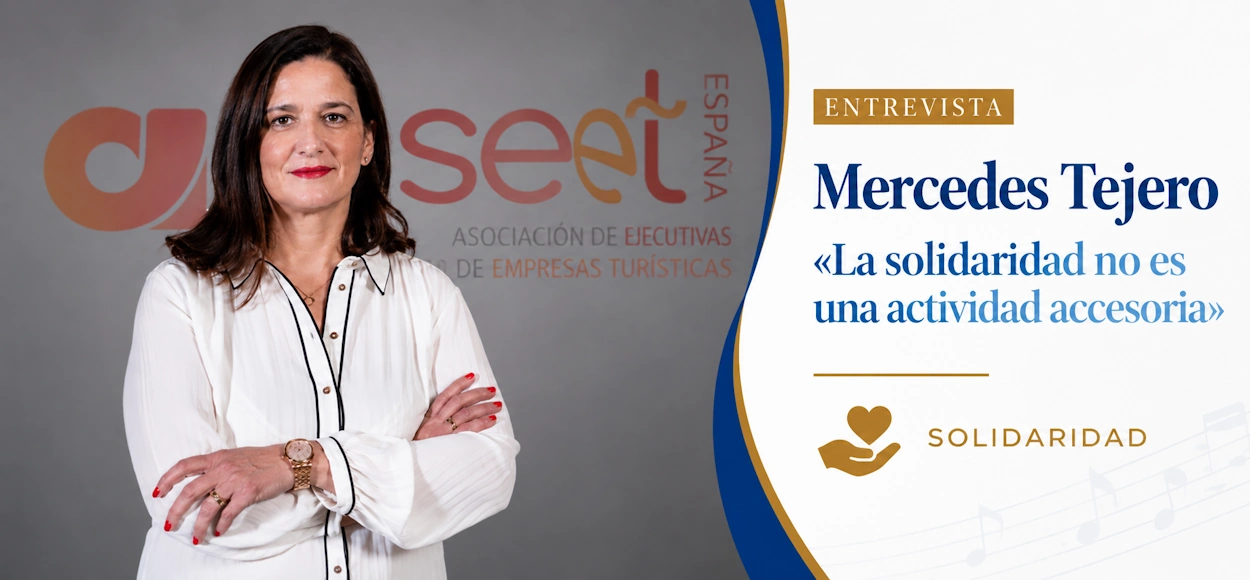
The vice-president of ASEET explains how the association is using its network of tourism professionals to support social projects and mobilise the sector.
Tourism connects people, businesses and places. For the Association of Women Executives in Tourism (ASEET), this ability to connect also brings with it a responsibility towards society.
From the outset, the organisation has incorporated Corporate Social Responsibility into its activities, collaborating with social organisations and projects and mobilising members, companies, sponsors and tourism professionals in support of them.
But behind the financial contributions, the galas and the charitable initiatives lies something less visible: hours of volunteer work, contacts, the ability to organise and a professional network placed at the service of people who need help.
Mercedes Tejero, vice-president of ASEET, explains to Sinergia Skål how the association understands this commitment and why she believes that professional success should be accompanied by a responsibility towards society.
Mercedes, why did ASEET decide that solidarity should have its own place within its activity?
From the very beginning of ASEET, we knew we wanted to be more than just a professional network. We are women who hold positions of responsibility in the tourism sector, and we believe that this also carries a responsibility towards society.
Tourism is also an activity deeply connected to people. Our work involves connecting people, cultures and places, so it seemed natural to us that part of our activity should be devoted to giving something back to society.
For ASEET, solidarity is not an additional activity, but an expression of our values and our understanding of leadership.
How does that commitment translate into concrete and measurable actions?
For us, it means moving from words to action. CSR truly makes sense when we are able to identify a need, find an organisation working on the ground and determine what we can contribute to achieve a specific result.
We try to ensure that each initiative has a defined objective and that we can later determine its impact.
And we're not just talking about financial contributions. We can also provide visibility, contacts, the ability to bring people together, professional knowledge and access to companies that can collaborate. Our main asset is precisely the network of professionals that makes up ASEET, and we also want to put it at the service of social causes.
How do you choose the causes and organisations you collaborate with?
We strive to select projects where we can clearly identify the need and, above all, understand the purpose and impact of our collaboration. We seek out serious, committed organisations with specific projects where our contribution can make a real difference. Furthermore, we are particularly sensitive to the needs of children and women.
We also place great value on the human element. Behind every organisation are people who know the reality they work in intimately and who can tell us what they need. From there, we try to determine where ASEET can add the most value.
We don't aim to do everything. We prefer to focus our efforts on specific projects and to know that our collaboration is genuinely helping to improve people's lives.
Is there a story that explains better than any number why this work is worthwhile?
To give you an example, these are the words of one of the project managers:
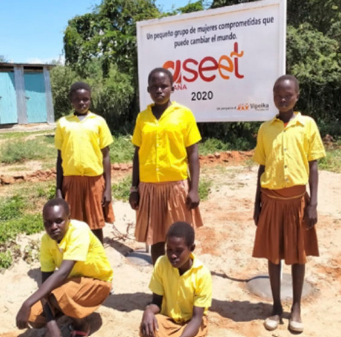
“These boys and girls you see in the video didn't go to school before. They spent their days collecting plastic, glass and cardboard from the city dump to earn a dollar a day for food. That was their only horizon. Now they're going to stay in school until they finish secondary education, and this is going to change their lives completely.”
He also explained that reaching that level of education would allow them to find a job and escape the cycle of poverty in which they and their future families might otherwise have remained.
And she ended by telling us that our help was opening doors for those boys and girls, giving them the chance of a far better life.
I believe those words are enough to make our effort worthwhile.
Beyond fundraising, what work goes into these initiatives?
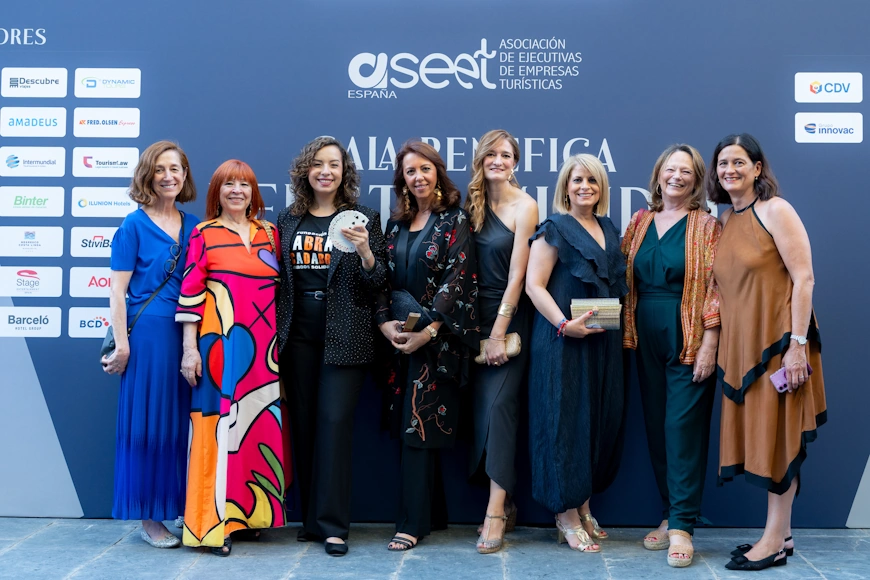
There's a lot of unseen work involved. A charitable initiative requires organization, finding collaborators, communication, coordination, fundraising, and above all, a great deal of personal commitment.
One of ASEET's greatest strengths is its members' ability to mobilise others. Each of them contributes her professional experience, her network and her ability to engage other people and companies.
Furthermore, the tourism sector usually responds with extraordinary generosity when we present a project we believe in.
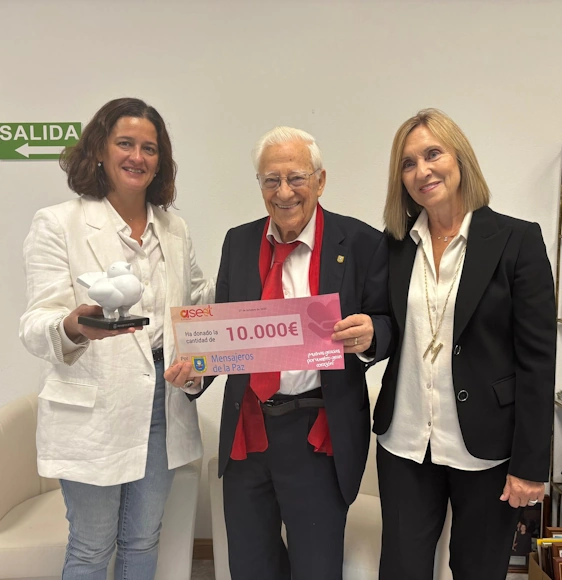
The galas and charity events are the visible result, but behind them lie many hours of volunteer work and an enormous chain of generosity involving members, sponsors, collaborators and companies.
Does this solidarity demonstrate that professional competition does not preclude collaboration?
Without a doubt. And I think that's one of the most beautiful aspects of these initiatives.
Tourism is a highly competitive sector, like any business, but at the same time it has an extraordinary capacity for collaboration. When there's a worthwhile cause, many of the barriers we encounter in our daily work disappear.
In our solidarity initiatives, we see professionals and companies sitting around the same table who compete in the market but, on that particular evening, share exactly the same objective.
This demonstrates the maturity of our sector and also that collaboration and competition are perfectly compatible.
Does the professional experience of the women of ASEET bring a particular way of approaching social projects?
I think so. The women who make up ASEET are used to managing teams, budgets, projects, suppliers, negotiations, and complex situations. It's inevitable that we bring some of that professional experience to our charitable initiatives.
We know how to organise, find resources, build alliances and mobilise contacts. But there's another equally important element: we know how to network. ASEET was created precisely with that aim: to connect women executives from different areas of the tourism industry.
When we put that network to use for a social project, its capacity multiplies. One member knows a company, another can obtain a specific resource, another can provide visibility… and in this way, we ensure that many small contributions end up becoming something significant.
Is the social dimension sufficiently integrated into the strategies of tourism companies?
We've made a lot of progress, but I think we still have a way to go.
For years, when we talked about sustainable tourism, we focused primarily on its environmental dimension. Today, we understand much more clearly that sustainability also has an economic and, above all, a social dimension.
A sustainable tourism company must ask itself what impact it has on people, how it contributes to employment and local development, how it relates to communities in the destinations where it operates, and what it can contribute to improving their well-being.
We are increasingly seeing tourism companies incorporate these criteria into their overall strategy, rather than treating them as isolated actions. In my opinion, that is the path we should follow.
What would you recommend to a company that wants to start working on CSR?
The first thing I would tell them is that it's not necessary to start with a huge project. Sometimes we want to do something extraordinary, and that prevents us from starting with something simple.
The key is to identify a cause that aligns with the company's values, to fully understand the organisation you want to collaborate with, and to establish a medium- to long-term relationship. Continuity is far more valuable than a spectacular but isolated action.
I would also recommend involving employees. When CSR is no longer solely a management decision and teams participate, propose initiatives and are informed of the results, it truly begins to become part of the company culture.
And, of course, results must be measured and communicated, not as a marketing tool, but as a form of transparency and as a way of creating a multiplier effect that encourages others to participate.
What role can professional associations like ASEET play?
We can play an extraordinarily useful role as a bridge between both worlds.
A professional association knows its member companies, has the ability to bring people together, and possesses a network of contacts that a small social organisation could hardly build on its own. At the same time, we can introduce our member companies to social projects we already know and provide them with a simple and reliable way to collaborate.
In addition, the tourism sector has resources that can be extremely valuable beyond financial contributions: accommodation, transport, experiences, communication, venues, professional expertise and promotional reach.
Our job can consist precisely in connecting a specific need with someone who has the ability to respond to it.
How can a company or professional collaborate with ASEET's solidarity projects?
There are many ways to collaborate, and all of them are important. We obviously need financial contributions because they allow us to fund projects directly, but companies that contribute products or services, professional expertise, venues, promotion or other resources to our charitable initiatives are also essential.
And we need people. People who participate, who spread the word about our initiatives, who connect us with new businesses and who help us expand this solidarity network.
Therefore, I would encourage any professional or company reading this interview to contact ASEET. There's no need to come to us with a fully developed proposal. We can talk, explore what you can contribute and find the best way to channel that collaboration together.
Mercedes Tejero, what would you like to achieve in the coming years?
Our goal is to continue growing, but above all to ensure that our capacity for impact is ever greater.
We would like to consolidate this charitable dimension as an integral part of ASEET and involve a growing number of members and companies in the sector. Personally, I believe we must pay special attention to projects related to children, women and people in particularly vulnerable situations.
I would also like us to do even more of what we do best: connecting people. ASEET has an extraordinary network of women executives and professionals, and the tourism sector has an enormous capacity to mobilise.
If we can bring these two forces together around solid social projects, we can achieve far more than we initially imagined.
Ultimately, our goal is very simple: to ensure that professional and business success is always accompanied by a commitment to the society of which we are a part.