

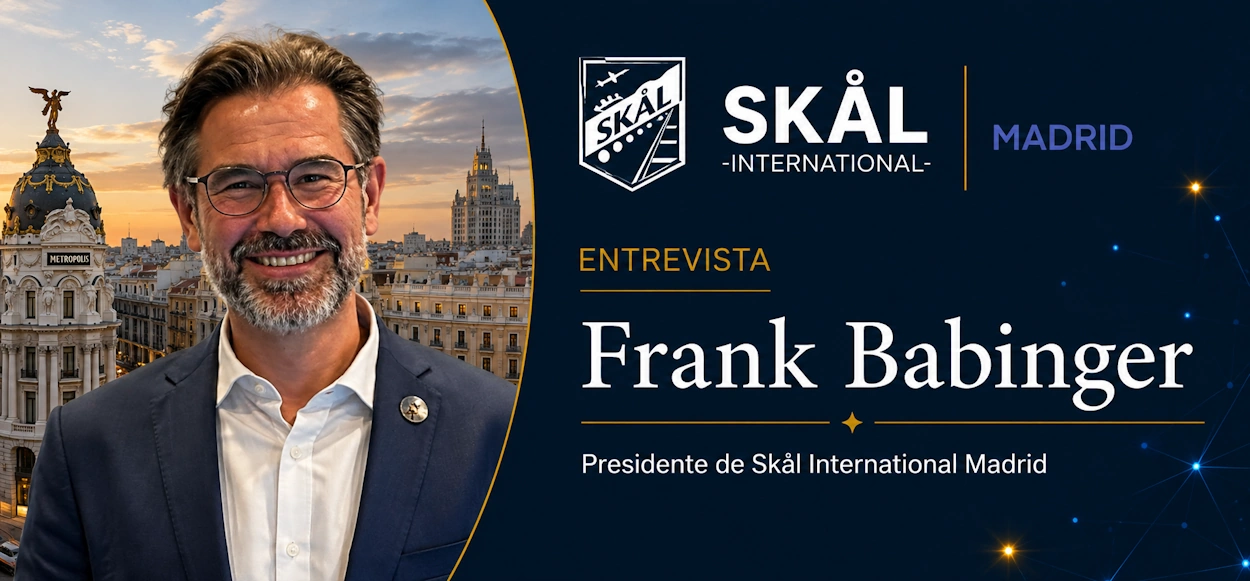
President of Skål International Madrid · Professor at the Faculty of Commerce and Tourism, Complutense University of Madrid
At the helm of Skål International Madrid is a professional who brings a particularly interesting perspective to tourism. Frank Babinger combines his responsibilities as president of the Madrid club with university teaching and an academic career closely linked to tourism, the region and its development.
His daily contact with those who will become the tourism professionals of the future and, at the same time, with the sector's business and professional community gives him a unique perspective from which to discuss the present and, above all, the challenges that lie ahead for Skål.
In Leading Skål, we spoke with Frank Babinger about Madrid, university life, new generations and the role that Skål can play in the future of tourism.
1. Frank, you have just taken over as president of Skål International Madrid. What does it mean to you to be at the head of the club and what led you to take on this responsibility?
For me, taking on the presidency of Skål International Madrid represents, above all, a great responsibility and also a tremendous source of enthusiasm. Skål is an organisation with a long history and something I consider especially valuable in the world of tourism: the ability to connect professionals from very different fields, build trust and create opportunities for collaboration.
I accepted this responsibility because I believe we are at a particularly exciting time for both tourism and Skål. The sector is changing rapidly, and we need spaces that allow us to share experiences, knowledge and projects while also embracing new perspectives and new generations.
Drawing on my experience as a professor and researcher in tourism, as well as my relationships with professionals and companies in the sector, I would like to contribute precisely to that: bringing together worlds that sometimes operate too independently. Universities, businesses, institutions and young professionals have much to offer and much to learn from one another.
I am therefore approaching this new stage with the intention of listening carefully, contributing wherever I can and working to make Skål Madrid an increasingly active, open and connected club, closely engaged with the tourism community around us.
2. How would you define Skål Madrid today, and what do you think distinguishes it within Skål?
Today, I would define Skål Madrid as a meeting place for tourism professionals, although I think it is important to go a little beyond that definition. Skål offers something particularly valuable: it combines professional relationships with friendship, trust and the opportunity to share experiences among people working in very different areas of the sector.
In Madrid, we also have an extraordinary opportunity. We are in a cosmopolitan city, one of Europe's great tourism capitals, where companies, institutions, universities, associations and professionals from virtually every area of the tourism industry come together. This diversity is, in my opinion, one of our club's greatest strengths.
I would like Skål Madrid to become an increasingly open and dynamic meeting point, capable of bringing together highly experienced professionals and those who are just beginning their careers. I believe we need to make much better use of our ability to generate knowledge, contacts and projects.
And there is something I consider fundamental: Skål should not simply be an organisation that talks about tourism, but one that actively contributes to its development. Madrid is undergoing a major transformation as a tourism destination, and our club has the opportunity to be part of that conversation, contributing the experience of its professionals and connecting it with the new realities of the sector.
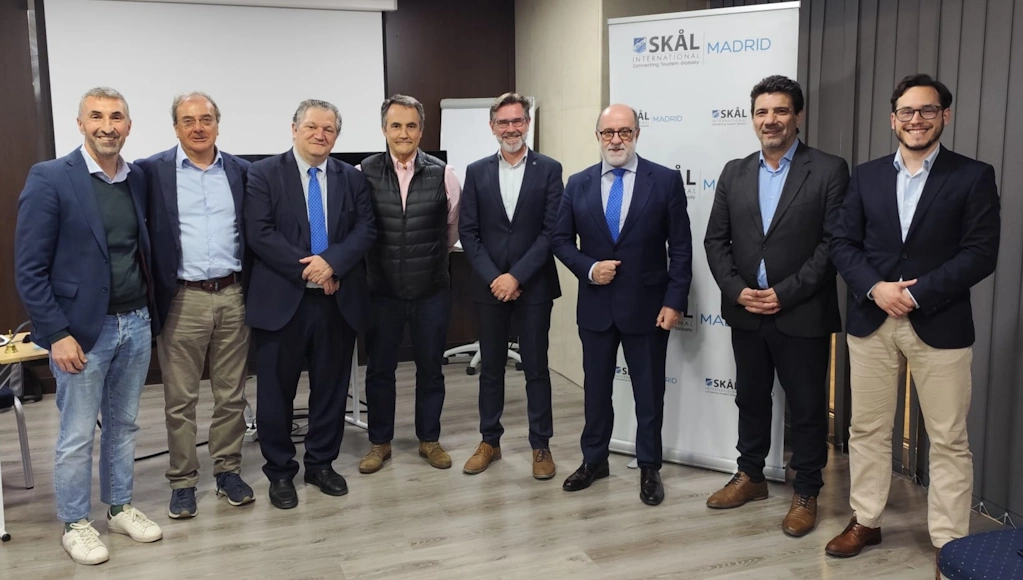
3. You spend a significant part of your professional life training future tourism professionals and managers. What would Skål need to do to become attractive to these new generations?
I believe that new generations do not need us to explain why Skål is important; they need to find reasons to be part of it. And those reasons must be connected to their own concerns and to the professional reality they will encounter.
Skål can offer them something that is incredibly valuable today: an international network of professionals, the opportunity to meet people from different areas of tourism, share experiences, create opportunities and learn from those with extensive experience. At the same time, however, we must be willing to listen to what young people themselves have to contribute.
I believe the challenge lies not only in bringing young people into Skål, but in making them feel that they have a meaningful role to play. It is about giving them space, responsibilities and the opportunity to participate in the club's projects and decisions. It also means using the new channels and forms of communication they are already familiar with.
From my experience at university, I see every day that tourism students have both interest and talent, but they need opportunities to connect with the professional world. That is where Skål can play an extraordinary role.
Ultimately, I believe we need to ensure that young professionals see Skål not as an organisation of the past, but as a network that can help them build their future. We need to establish and communicate the idea that Skål is where the experience of seasoned professionals and the talent of new generations come together to improve international tourism.
4. You have championed the importance of connecting universities with the professional realities of the tourism industry. Can Skål also become a bridge between universities, businesses, and new generations of professionals?
Absolutely. In fact, I believe this is one of the areas where Skål Madrid can add the most value. Universities and businesses need to work much more closely together, and an organisation like Skål can play a very interesting intermediary role because it brings together professionals with first-hand knowledge of the sector.
Universities can contribute knowledge, research, new perspectives, and above all, young talent. But we also need to listen more to businesses and understand their needs, the professional profiles they seek, and the challenges they face.
Skål can help create these meeting spaces. They do not necessarily have to be large-scale initiatives; sometimes a conversation between a student and a professional, a visit to a company, an informal exchange, a joint project or an internship can create a connection that helps shape a career path.
Furthermore, I believe the relationship should work both ways. Professionals can share their experience and knowledge of the industry with students, while also engaging with the university to learn about new ideas, research and different ways of understanding tourism.
I would like Skål Madrid to help build precisely that bridge: a space where universities, businesses and young professionals are not separate worlds, but part of the same tourism ecosystem.
Ultimately, the relationship between universities and businesses shouldn't be solely about universities preparing professionals for companies; it should be a two-way dialogue. In this sense, we must ensure that Skål also serves as a gateway to the industry for young people and as a gateway to university for professionals.
5. Madrid is experiencing a period of tremendous tourism growth. From your dual academic and professional perspective, what do you think are the major challenges facing the destination, and what role can Skål Madrid play?
Madrid is experiencing an extraordinary period in terms of tourism. The city has been gaining international prominence, as recently demonstrated by the Pope's visit, Bad Bunny's residency and the upcoming Formula 1 race, to name just a few examples.
It now boasts an increasingly diverse and sophisticated offering in cultural tourism, gastronomy, MICE and major events, and has considerable potential to further strengthen its international position. For this very reason, I believe the main challenge is no longer simply growth, but managing that growth in a balanced way.
Madrid must remain a competitive and attractive destination, while at the same time addressing issues such as coexistence with residents, mobility, pressure on certain areas, housing, environmental sustainability and the distribution of the benefits generated by tourism. I believe this must be done without falling into the trap of reducing the debate to being either for or against tourism. The focus should be on what kind of tourism we want and how we want it to contribute to the city.
In this context, Skål Madrid can play a significant role. We are an organisation made up of professionals who know the tourism industry from the inside and who bring very different perspectives: accommodation, restaurants, transport, travel agencies, institutions, education, events and more.
I believe our responsibility is to participate in this debate by contributing our experience and knowledge, but also by listening to other stakeholders in the city. Skål Madrid can offer this space for dialogue between the tourism sector, institutions, the university, and society.
Madrid doesn't simply need more tourism. It needs tourism that contributes to making the city a better place for visitors and, above all, for its residents. Clearly, tourism success generates new challenges, and Skål Madrid is an essential partner in helping to understand, address, and manage these changes.
6. Your academic work has focused on tourism, territory, and sustainability. At a time of intense debate about tourism growth, how can we find a better balance between competitiveness, sustainability, territory, and the quality of life for residents?
I believe we need to move beyond the idea that competitiveness and sustainability are opposing concepts. In the long run, a destination that is not sustainable cannot be competitive either. The real question is how we ensure that tourism generates value without shifting its costs onto the local area and its residents.
To achieve this, we first need to better understand what is happening in our destinations. We cannot manage what we do not measure: tourist flows, spatial and temporal concentration, resource consumption, mobility, housing, environmental impact and residents' perceptions. But data must be used to inform decisions, not simply to compile statistics.
I also think we need to change the question. For a long time, we have been asking ourselves how many tourists we can attract. Perhaps we should instead be asking what kind of tourism we want, what value it brings and how much tourism the destination can accommodate without damaging the very qualities that make it attractive.
And here, residents' quality of life must take centre stage. A tourism destination is not a stage built exclusively for visitors; it is, above all, a place where people live.
At Skål, I believe we can contribute to this debate constructively. The tourism sector must be part of the solution: innovating, reducing its impact, generating quality employment, and collaborating with institutions and other stakeholders in the region. We, the professionals at Skål International, are, I repeat, part of the solution, as we understand the needs of the sector, but also those of the destinations and their residents.
Ultimately, it's not about choosing between tourism and sustainability. It's about making tourism compatible with a livable, competitive, and sustainable territory.
7. If you had a young tourism professional in front of you who didn't yet know Skål, what would you say to explain why it's worthwhile to be part of this organisation?
I would advise them not to wait until they have twenty years of experience before starting to build their professional network. Tourism is, above all, a people-oriented sector, built on relationships and shared experiences, and getting to know other professionals can be just as important as the knowledge acquired at university, a training centre or within a company.
Skål offers precisely that opportunity: to meet professionals from very different backgrounds, learn from them, share ideas and discover opportunities, all within an international network. After all, it is the oldest and largest international network in the sector. Throughout our professional lives, a conversation, someone we meet or an opportunity that arises at just the right moment can change our path. Skål provides the environment in which those connections can happen.
But there is something I consider even more important. Joining Skål is not just about what you can receive; it is also about having the opportunity to contribute. New generations bring knowledge, concerns and different ways of understanding tourism that are essential for any organisation that wants to evolve.
That is why I would tell any young professional not to see Skål as something reserved for those with extensive experience. On the contrary, the sooner they start networking with other professionals, getting to know the industry and building relationships, the more opportunities they will have to shape their own path. In short, I would tell them one simple thing: come, meet people, participate and discover what Skål can offer you. You will probably also discover what you can contribute to Skål.
8. When your time as president is over, what would you like to have contributed to Skål Madrid and what kind of club would you like to leave for those who come after you?
First of all, I want to make it clear that the previous presidents, each in their own way, have set the bar very high, and I have inherited the club in excellent condition. That said, when my term as president comes to an end—always understood as a partnership with the Board of Directors—I would like to look back and feel that we have made Skål Madrid an even more open and dynamic club, more closely connected to the realities of tourism.
I would like to leave behind a Skål Madrid with a greater capacity to bring people together, generate knowledge, foster collaboration and create opportunities; a club that preserves the values that have brought it this far while remaining able to adapt to new generations and the changes taking place in tourism.
I don't believe a president should try to link their name to a specific period. What's important is to leave behind a stronger organization than the one they inherited and to lay a foundation that allows those who come after them to continue building upon it.
I would like to leave behind a Skål Madrid with a greater capacity to generate encounters, knowledge, collaboration and opportunities; a club that preserves the values that have brought it to this point, but that is able to adapt to new generations and the changes that tourism is undergoing.
And above all, I would like whoever takes over the presidency after me not to feel that they have to start from scratch, but rather to inherit a well-established project that they can continue to develop in whatever direction they consider appropriate. Because I believe that this is the true responsibility of anyone who leads an organisation: not to build something for themselves, but to help build something that will endure, evolving and adapting over time while always remaining aware of where it came from.
Finally, complete this sentence: “For me, Skål is...”
“For me, Skål is professional friendship that connects, builds and moves us towards the future.”