

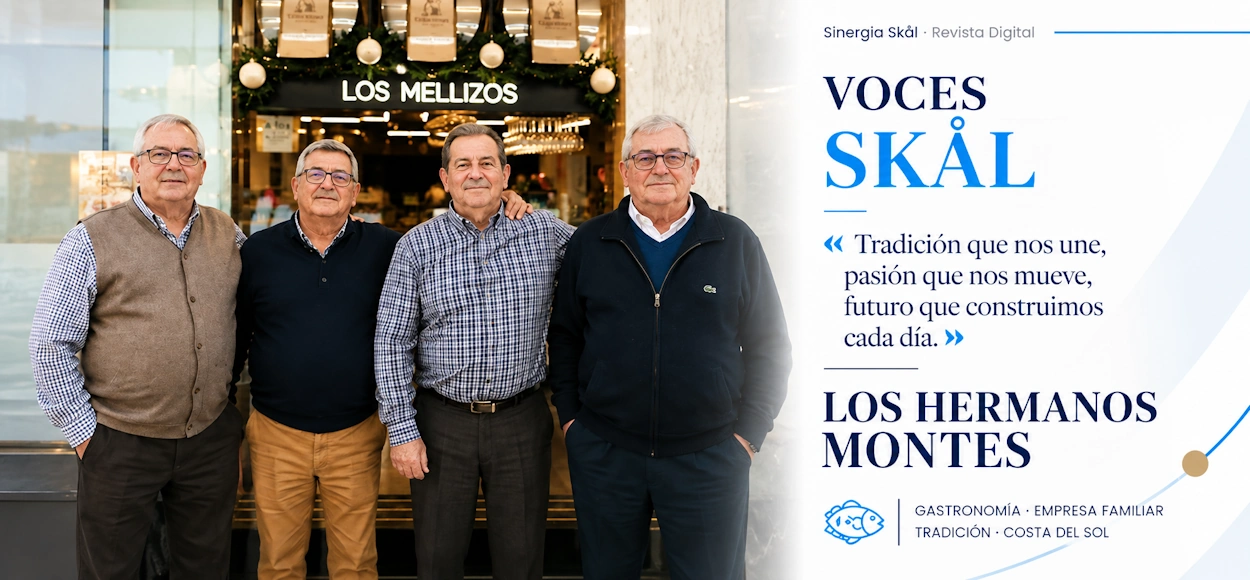
Four brothers, several generations, and a shared understanding of Malaga's gastronomy
Talk about The Twins It's about a family history linked to the sea, to fish, and to the hospitality industry in Malaga. A story that has grown alongside the Costa del Sol And that, after almost five decades, it continues to rely on a seemingly simple idea: to evolve without losing its roots.
Today, with establishments in different parts of the Costa del Sol and a new generation joining the project, the family faces the future with the same identity that has defined its journey: product, closeness, tradition and a distinctly Malaga way of enjoying time around the table.
In Voces Skål we talked with the Montes brothers about gastronomy, tourism, family business, generational change and the challenges of a sector that has changed profoundly while still looking to its origins.
Los Mellizos has been linked to Malaga's gastronomy for over four decades. What has changed in these years in the way the restaurant industry is understood, and what remains unchanged?
Today's customer is much more demanding, better informed, and seeks not only good food but a complete experience. Facilities, technology, customer communication, and business management have also changed dramatically. We've had to adapt to new trends, new consumption habits, and a much more competitive environment.
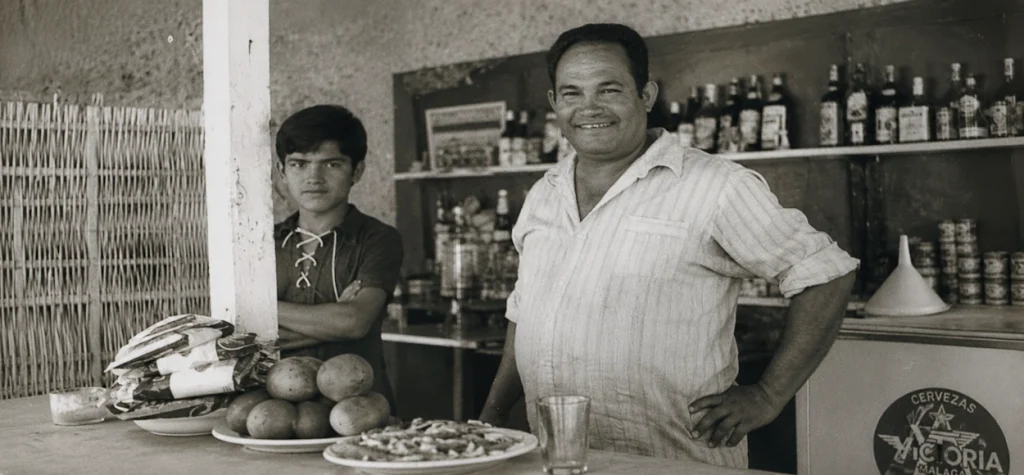
But one thing remains unchanged: our essence. Los Mellizos was born from a family with deep roots in the fishing industry, the sea, and the hospitality sector, and that passion for our products continues to be our core value. From the very beginning, with our parents Pepe Montes and Loli Montero, we have maintained our commitment to the quality of our raw materials, especially fish and seafood, and to a cuisine based on Malaga's culinary traditions.
Something fundamental also remains: our welcoming atmosphere. We want our guests to feel at home and different generations of the same family to continue enjoying our restaurants. Our philosophy is simple: to evolve in every way necessary, but without ever abandoning our roots.
Fried fish, shellfish, rice dishes, and seafood are all part of your identity. To what extent has traditional Malaga's gastronomy become a tourist attraction in its own right?
Without a doubt, traditional Malaga cuisine has become a tourist attraction in its own right. For a long time, tourism on the Costa del Sol was closely associated with sun and sand, but today visitors also seek to experience the destination through its flavors, products, and traditions.
Fried fish and sardines on skewers are probably the best examples. They're not just dishes to eat on vacation, but part of Málaga's identity and culture.
For us, it's a wonderful responsibility to help visitors discover Málaga through our cuisine. A delicious plate of fried fish, seafood rice, prawns, or grilled sardines can become part of the memories that visitors take away from our region. Gastronomy doesn't just accompany tourism; it can be one of the reasons for choosing a destination.
The Costa del Sol is attracting visitors who are increasingly seeking experiences beyond just sun and sand. What role does gastronomy play in this transformation of the destination?
Gastronomy plays a fundamental role because it allows you to experience a destination in a much more authentic way. The Costa del Sol is no longer marketed solely as a place of sun and sand, but as a region with culture, traditions, products, and its own unique identity. And gastronomy is one of the best ways to convey all of that.
Furthermore, it helps to diversify and reduce the seasonality of tourism. A beach depends heavily on the time of year, but the cuisine can be enjoyed year-round.
Restaurants also have a responsibility in this process: to preserve our identity and, at the same time, make it attractive to new generations and to those who visit us from other countries. If a tourist leaves Malaga thinking about our dishes and wanting to enjoy them again, we are helping to make gastronomy an integral part of the Costa del Sol travel experience.
Los Mellizos currently has establishments in various locations along the Costa del Sol. How do they manage to grow while maintaining a recognizable culinary identity?
Growing without losing your identity is probably one of the biggest challenges for a family business. In our case, the key has been being very clear about what we don't want to change. We can adapt the spaces, incorporate new offerings, use new management tools, or open in different areas, but there are some pillars that must remain: the product, the quality, the service, and our way of understanding Malaga cuisine.
Each establishment has its own personality, shaped by its location and clientele. Being in the heart of Málaga, on the seafront in Marbella, or in a traditional square in Fuengirola are not the same. But when a customer enters any of our restaurants, they should immediately recognize that they are at Los Mellizos.
Furthermore, our fishmonger business allows us to control a significant part of the process, from purchasing the product to its arrival at the table. And there's another essential element: family. Expansion isn't simply about opening more restaurants, but about bringing the same philosophy to every establishment.
Do you perceive differences between what the local customer is looking for and what the national or international visitor is looking for?
Yes, although those differences are becoming less noticeable. Our local customers are more familiar with our cuisine, have their favorite dishes, and in many cases, come looking for what's already part of their culinary traditions. For us, these long-time customers are especially important: their loyalty has been fundamental to Los Mellizos' success.
International visitors often arrive with a greater curiosity to discover the unique flavors of Málaga. Fried fish, seafood, rice dishes, and Mediterranean cuisine can be a new experience for them and a way to connect with our culture.
But both are looking for the same essentials: a good product, friendly service, and a worthwhile experience. Our goal is for someone from Malaga who has been coming for years and someone visiting us for the first time from another country to leave equally satisfied.
Gastronomy also plays a part in the image a destination projects abroad. Do you think Málaga and the Costa del Sol are making the most of their culinary potential?
Málaga and the Costa del Sol are making a significant effort to showcase their gastronomic potential, and the results are becoming increasingly visible. Gastronomy now plays a much more prominent role in promoting the destination.
Even so, we have plenty of room to grow. Málaga boasts enormous wealth: seafood and fried fish, wines, olive oils, fruits, produce, and a traditional cuisine steeped in history. The challenge is to ensure that all this heritage is known beyond Málaga with the same prominence as our climate, our beaches, or our cultural offerings.
We must continue working together, institutions and businesses. We have products, tradition, talent, and a unique identity; now we must transform all of that into an internationally recognized gastronomic brand. Restaurants have an important responsibility: to preserve that identity, to share it with visitors, and to demonstrate every day that Malaga's gastronomy deserves to be among the top attractions of our destination.

How important is it for a family business in the sector to be part of a professional organization like Skål?
For a family business like Los Mellizos, being part of Skål is invaluable because it allows us to connect with the entire tourism sector, not just the restaurant industry. Skål brings together professionals from different areas and facilitates the exchange of experiences, contacts, and opportunities both locally and internationally.
Furthermore, belonging to a professional organization is a way to continue learning. The hospitality industry is constantly evolving, and sharing experiences with other professionals helps us to learn about new trends, understand how tourism is changing, and identify opportunities that we might not notice in our day-to-day work.
Generational succession is one of the biggest challenges for many family businesses. How is Los Mellizos addressing the continuity of the project?
We're experiencing the generational transition very naturally, because it's part of our own history. We're currently the second generation leading the company, and we're seeing the third generation—our children—join the family business. We've received from our parents not only a business, but also values, a way of working, and a way of understanding gastronomy that we try to maintain and pass on.
Continuity isn't simply about one generation replacing the previous one. What's important is that those joining the company understand the business from the inside out and appreciate the effort behind it. At the same time, each generation must contribute its own perspective and adapt to the changing times.
That's one of the keys to family businesses: preserving their essence without getting stuck in the past. We must evolve in management, communication, technology, and our relationships with our customers.
For us, true success is ensuring that what began as our parents' dream continues with the addition of the third generation, maintaining the essence of Los Mellizos, but allowing each generation to write its own chapter.
What do you consider to be the main challenges facing the restaurant industry on the Costa del Sol: staff, costs, product, sustainability, customer expectations…?
There are several, but we would especially highlight the staff, the increase in costs and the need to maintain increasingly higher quality standards.
Talent is one of the biggest challenges. We're not just talking about finding workers, but about finding qualified professionals and making the hospitality industry a sector where they want to build a career.
There are also rising costs: raw materials, energy, personnel, rent… Companies have to find a balance between being competitive and maintaining quality. In our case, this is especially important because the product is a fundamental part of our identity, and we don't want cost control to affect what we offer our customers.
Sustainability will become increasingly important: being more efficient in water and energy, reducing food waste and using resources responsibly.
But all these challenges are also opportunities. The Costa del Sol is experiencing a period of immense tourist appeal, and gastronomy has much to contribute. The challenge is to grow sustainably, further professionalize the sector, and ensure that this growth is accompanied by quality and positive customer experiences.
If you had to recommend just one dish to a visitor to understand the gastronomic essence of Malaga, what would it be and why?
If we had to choose one, we'd probably recommend a good Malaga-style fried fish platter. It's hard to find a dish that better represents our relationship with the sea, with the local produce, and with our traditional way of eating. Fried fish, along with espeto (skewered sardines), is one of Malaga's great culinary symbols.
Fried fish also perfectly reflects our approach to gastronomy: fresh ingredients, good technique and very little fuss.
And it's a dish meant to be shared. Malaga's cuisine is all about gathering around a table, ordering several things, and enjoying them together. A fried fish dish embodies precisely that: the sea, tradition, simplicity, and the open, family-oriented character of Malaga.
If we could pair it with a skewered sardines, we'd practically have a small representation of our culinary identity. But if we can only choose one, we'll go with the fried fish.