

Fifty years of music, a life linked to tourism, and a new way of understanding what is truly important.
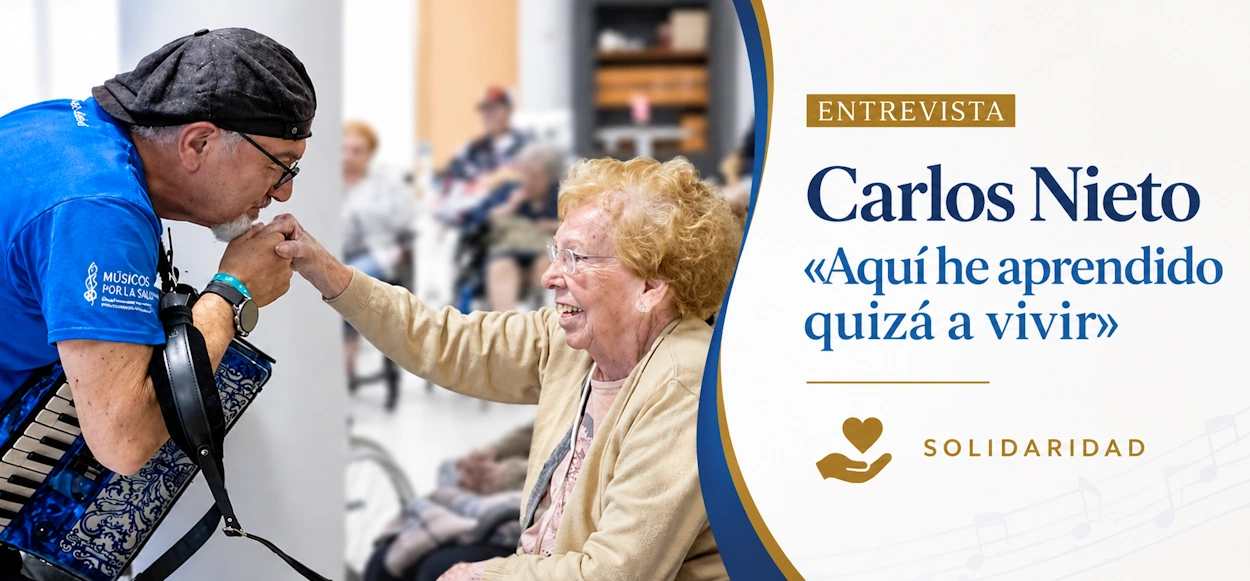
Carlos Nieto and Musicians for Health They star in a story where music, the solidarity And the value of life meet. For years, both worlds coexisted amid working days, rehearsals, orchestras, bands and projects that helped incorporate leisure activities into the offerings of travel agencies. They even crossed paths at sea, when he and his band performed a Beatles tribute set during a cruise.
But a hospital stay changed the course of his relationship with music. There, he discovered a poster for Musicians for Health, auditioned and decided to volunteer. Three years later, those first thirty songs have grown into a repertoire of more than a thousand, learned largely by listening to requests from patients and residents. After celebrating fifty years on stage, Carlos decided to step away from conventional performances to devote his music to hospitals and nursing homes, while continuing as director of the choir at the Galician Centre of Madrid.
In this conversation with Sinergia Skål, he talks about tourism, music, illness, friendship, and something he places above almost everything today: the value of life.
Carlos, those of us who know you from the tourism sector may not know this other side of your life. What came first, tourism or music, and how have both worlds coexisted all these years?
Music came first. I've been studying it since I was ten. Tourism came later, thanks to an art history professor who introduced me to the field and instilled that passion in me. I'm very proud to have worked in tourism.
How have we managed to balance them? By making time. You know how incredibly demanding our work in tourism was, but I needed to set aside time for my instruments. I've dedicated at least an hour or an hour and a half every single day to playing and rehearsing. Then there were the rehearsals with the orchestras and bands I've played with.
And once, those two worlds came together. At Mucho Viaje, we had the ship Julio Verne, and with one of the bands I played in, we performed a Beatles tribute show during a ten- or twelve-day cruise. It was a lot of fun.
You've just celebrated fifty years on stage. What does it mean to you to have maintained that relationship with music for half a century?
I celebrated my fiftieth anniversary on stage on 10 May and decided to retire from performing, except for two things to which I remain very attached: Musicians for Health, playing in hospitals and nursing homes, and my work as director of the choir at the Galician Centre of Madrid. Musicians for Health, playing in hospitals and nursing homes, and my work as director of the choir of the Galician Center of Madrid.
I never imagined I'd remain active in music for so long. Art enriches your life immensely and, in my case, it has also been closely intertwined with my professional career. For the past twenty-odd years, I've focused on integrating leisure activities into the travel industry: tickets to musicals, theme parks and other products that were virtually non-existent in the sector at the time. Today, leisure has even become a tourism product in its own right.
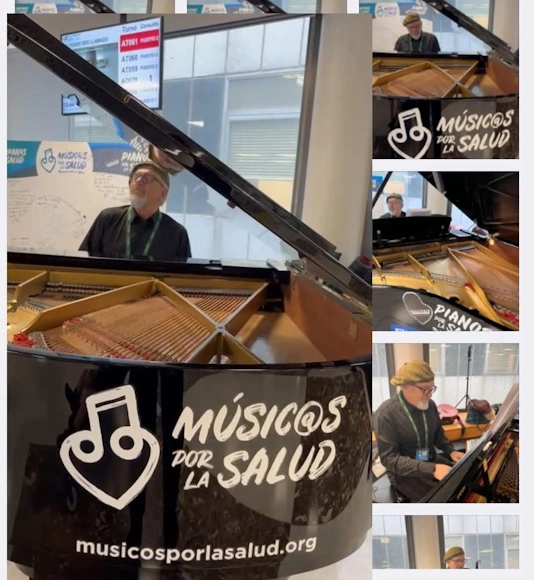
Carlos Nieto and Musicians for Health
How did you get involved with Musicians for Health and what led you to become a volunteer?
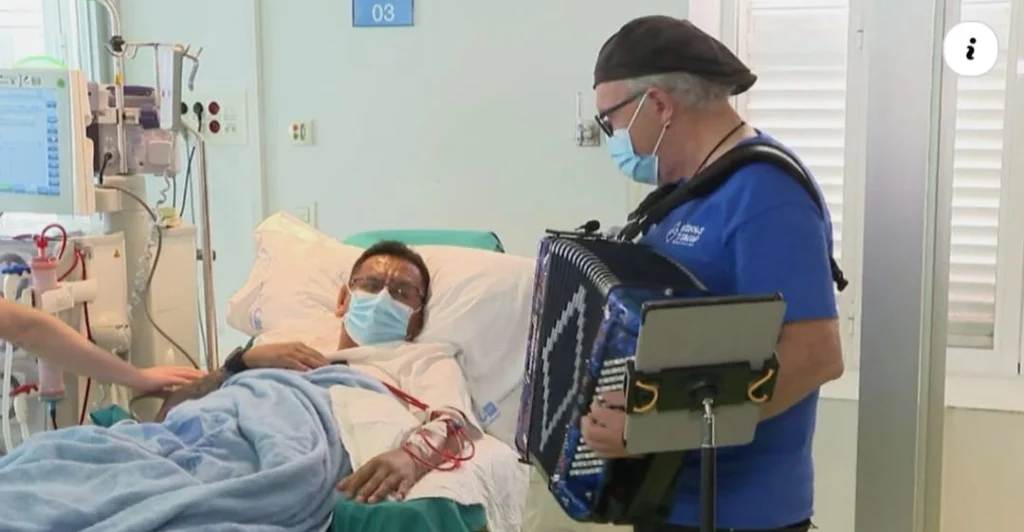
I became involved while I was in hospital. Unfortunately, I've suffered from several illnesses: heart problems, kidney cancer and COVID, which affected me greatly and from which I still experience lingering effects. Walking down one of the corridors, I saw a poster looking for musicians for Musicians for Health. I signed up and sent videos of myself singing and playing guitar, accordion and piano—the piano is really my main instrument—and then did the audition.
They offered me the option of working part-time or volunteering. I was absolutely certain: I wanted to volunteer. I had already worked for over forty years in my profession.
And that marked a turning point, not only in music, but in my life. Here I've perhaps learned how to live, to live in peace and to focus on what truly matters: your family, your children, your partner, your loved ones. Working with Musicians for Health fills me with peace every day.
When you started, how did you prepare to play in front of patients and residents?
I prepared myself to perform for a completely different audience. I undertook training and studies related to musicology. At a conventional concert, you bring your repertoire and perform it; here, it works differently.
I started with about thirty songs, and now my repertoire exceeds a thousand. I've learned many of them from patients and residents. I see quite a few of them every week, and they're the ones who ask me for new songs. I prepare them and, with pleasure, add them to my repertoire.
You've performed for many audiences. What changes when the stage is a hospital or a nursing home?
Everything changes. The first day I set foot in a hospital, I realised that playing in the bands and orchestras I'd been part of didn't have the same meaning for me as being able to play in these places. That doesn't mean those experiences weren't important, but this is on another level.
That's why, when I turned fifty on stage, I decided to leave conventional performances and dedicate myself fully to hospitals and nursing homes.
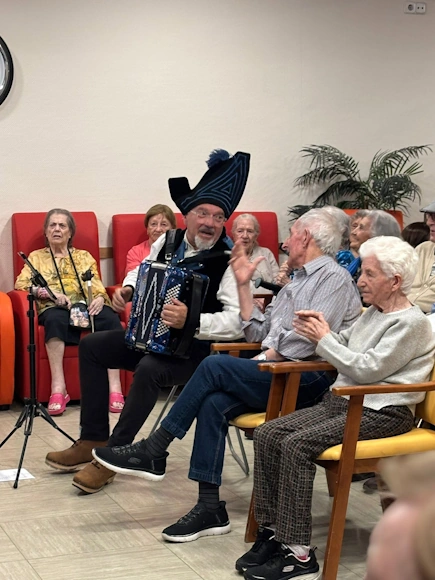
After so many years working with people in tourism, what have you discovered about people by playing for them in a hospital or care home?
The difference lies in the value of life. When you're immersed in the world of business, work and the economy often take precedence. Here, the value lies in life itself.
You can sing a song for two people or for twenty and be happy doing it. They are happy in that moment, and I am very happy singing to them.
You work in very different settings and with very different patients. Is there anything that is common to all of them?
I work in oncology, dialysis, intensive care, geriatrics, paediatric units, psychiatry... and there's a common denominator: peace. Peace and the feeling of being useful.
There are people in great need, and not everyone has family who can visit them, whether in a care home or a hospital. At that moment, you can become a companion, a source of comfort and closeness, even if only for a while. They shake your hand, you get a smile... Some intubated and partially sedated patients even start tapping their feet to the rhythm.
That's when you understand the power of music. I'm not talking about healing in a medical sense, but about improving the patient's comfort and well-being. It helps tremendously.
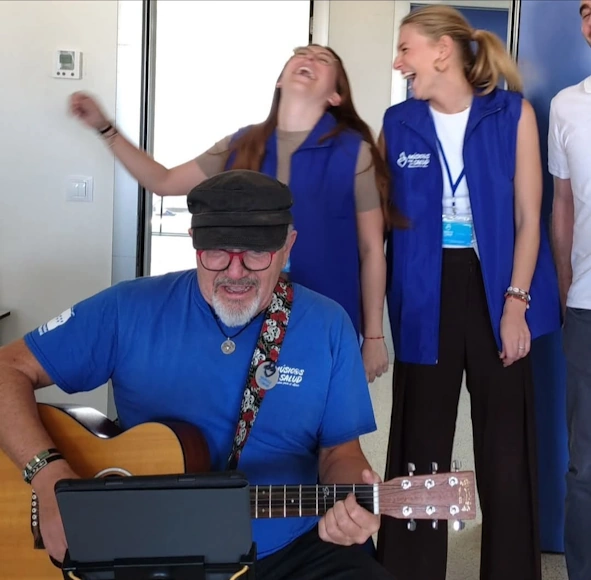
Tourism and music seem like different worlds. Do you think one has influenced your approach to working in the other?
Very much so. A company is quite similar to an orchestra: it's impossible for anything to work, or for the music to sound good, if the instruments are out of tune or the musicians don't follow the score.
In my case, music has been useful in tourism and in the companies I've worked for. It's helped me to be organised. Music is pure mathematics, and that discipline has helped me tremendously.
After fifty years in music and a long professional career, what still excites you and what is left for you to do?
I'm still very excited. In music, as in tourism, you never stop learning, and you have to keep up to date every day. Patients and residents keep asking me for new songs, and I keep studying.
What do I want to do? Continue making music and playing in the places where I'm currently performing. And what do I need for that? Health. Health.
COVID left me with lasting effects, and I'm also having increasing problems with my vocal cords, so I have to take extra care of myself. When my voice isn't right, I can play the piano or bring my accordion, which my patients also really enjoy.
What I wish for is to have health so that I can continue doing this work for a long time and continue to keep my friends.
If you had to choose one song that especially represents this stage of your life, what would it be?
Without a doubt, “Life Is Beautiful”, from the film Life Is Beautiful. It's a song that's very close to my heart and moves me deeply; sometimes I even shed a tear when I perform it. Patients in hospitals are incredibly grateful for it.
In the care homes, the repertoire is different. For a long time, pasodobles and Spanish music predominated, songs linked to memories. But younger residents are arriving who have listened to the Beatles, the Rolling Stones, or Eric Clapton, and they increasingly request that type of music.
“Life Is Beautiful” was already among the first thirty songs I started with three years ago. Today, my repertoire exceeds one thousand.